
4/12 Roof Pitch
The minimum standard for asphalt shingles and one of the most common pitches in US residential construction. Here is everything about 4/12 – the 18.43 degree angle, rafter lengths for every building width, why it is the critical shingle threshold, and exactly what it can and cannot do.
What Is a 4/12 Roof Pitch?
A 4/12 roof pitch means the roof surface rises 4 inches vertically for every 12 inches of horizontal distance. The first number is the rise; the second is always 12, representing one foot of run. You will also see it written as 4:12, 4-in-12, or 4 over 12. All mean the same slope.
In degrees, 4/12 equals 18.43 degrees – calculated as arctan(4/12) x (180/pi). From the ground, a 4/12 roof looks relatively flat – significantly shallower than the 6/12 pitch most people picture when they imagine a “normal” house. Yet it is steep enough to drain efficiently under normal rainfall and, critically, steep enough to meet the IRC minimum for standard asphalt shingle installation without any modifications.
What Makes 4/12 Unique Among All Pitches
The 4/12 pitch has a character that no other pitch shares: it sits exactly at the regulatory and performance threshold for standard asphalt shingle installation. This makes it simultaneously the best choice for certain applications and the worst for others, depending entirely on your priorities.
- It is the lowest pitch with full material freedom. At 4/12, every standard shingle, metal panel, tile, shake, and synthetic product can be installed with standard methods. One step shallower at 3/12 and you lose access to most shingle products without special low-slope modifications.
- It has the smallest material quantity premium of any pitched roof. The pitch factor of 1.054 means you are ordering only 5.4% more material than the flat footprint. Compare that to 11.8% at 6/12 or 41.4% at 12/12. For large commercial or agricultural buildings, this translates to real savings.
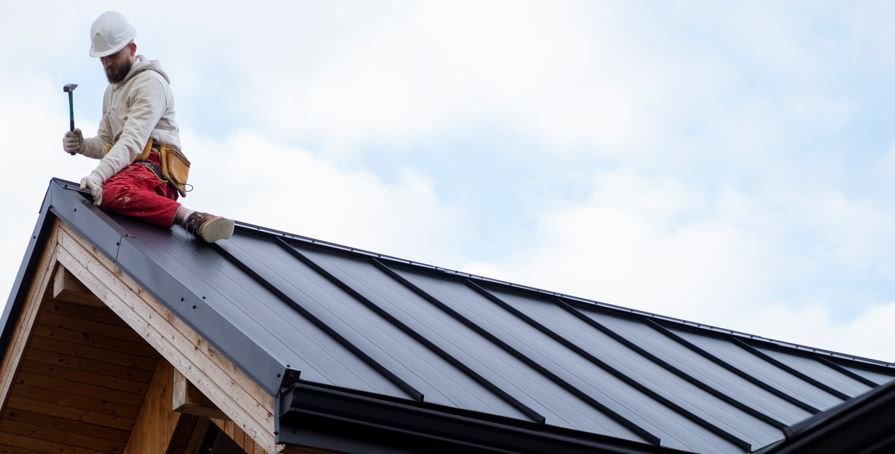
- It is safe to walk without special equipment. Well below OSHA’s 7/12 steep-slope threshold. No harnesses, no roof jacks required – standard safety setups apply.
- It creates very limited attic headroom on standard building widths. On a 28-foot house, the 4/12 ridge reaches only 5 feet 8 inches above the top plate – below the 6-foot threshold most people consider practical for storage.
- It underperforms in heavy snow zones. At 18.43 degrees, snow does not slide reliably under gravity. In climate zones 5 and above, a 4/12 roof accumulates snow load and requires structural engineering for ground snow loads above 20 psf.
Why 4/12 Is the Minimum Pitch for Asphalt Shingles
The 4/12 minimum is not arbitrary. It is rooted in how shingles work as a water-shedding system. Shingles are not a waterproof membrane – they are an overlapping system that relies on gravity-driven water flow to shed water off each course before it can infiltrate the lap joint below. At pitches below 4/12, three problems emerge simultaneously:
At pitches below approximately 18 degrees (4/12), water moves slowly enough that surface tension and capillary action can draw it backward under the shingle tabs at lap joints. Standard shingle overlap dimensions (5 to 6 inches of exposure) are calculated for pitches of 4/12 and above. Below this, the overlap is insufficient to prevent back-flow under the tabs during moderate to heavy rain.
Slow-draining pitches below 4/12 allow meltwater from snow to move more slowly to the eave edge, increasing the risk of refreezing before it leaves the roof. Ice dam formation traps standing water behind the dam, which then wicks under shingles via capillary action. The 4/12 minimum is the point at which standard eave ice-and-water shield protection plus proper ventilation provides adequate protection in climate zones up to 5.
Roof valleys at low pitches accumulate water faster than it drains. Woven valley installations (which are standard at 4/12+) become inadequate below 4/12 because water volume in the valley exceeds the drainage capacity of the shingle overlap. Below 4/12, open metal valleys with wider exposed metal are required, adding cost and complexity.
Between 2/12 and 4/12, asphalt shingles can be installed with a low-slope modification per IRC R905.2.2. This requires: (1) double underlayment with 19-inch overlap (vs standard 2-inch overlap), OR full-coverage ice-and-water shield under the entire deck, AND (2) reduced shingle exposure to increase the lap. This adds $65 to $95 per square to material cost and is not available below 2/12 at all.
Rafter Length Table: Every Standard Building Width
The table below gives the precise structural rafter length and full rafter length (including a standard 12-inch eave overhang) for a 4/12 pitch on every common building width from 16 to 60 feet. Adjacent pitches (3/12 and 5/12) are shown for direct comparison. Note how close the 4/12 rafter lengths are to the 3/12 column – the 5.4% pitch factor means a barely longer rafter for a significant gain in material compatibility.
| Building Width | Run (half-width) | 3/12 Rafter | 4/12 Rafter ★ | 5/12 Rafter | 4/12 + 12″ OH | Lumber to Buy |
|---|---|---|---|---|---|---|
| 16 ft | 8 ft | 8′ 2″ | 8′ 5″ | 8′ 8″ | 9′ 7″ | 10 ft |
| 18 ft | 9 ft | 9′ 3″ | 9′ 6″ | 9′ 9″ | 10′ 7″ | 12 ft |
| 20 ft | 10 ft | 10′ 3″ | 10′ 7″ | 10′ 10″ | 11′ 8″ | 12 ft |
| 22 ft | 11 ft | 11′ 4″ | 11′ 7″ | 11′ 11″ | 12′ 9″ | 14 ft |
| 24 ft | 12 ft | 12′ 4″ | 12′ 8″ | 13′ 0″ | 13′ 9″ | 14 ft |
| 26 ft | 13 ft | 13′ 5″ | 13′ 9″ | 14′ 1″ | 14′ 10″ | 16 ft |
| 28 ft | 14 ft | 14′ 5″ | 14′ 9″ | 15′ 2″ | 15′ 11″ | 16 ft |
| 30 ft | 15 ft | 15′ 6″ | 15′ 10″ | 16′ 3″ | 16′ 11″ | 18 ft |
| 32 ft | 16 ft | 16′ 6″ | 16′ 10″ | 17′ 4″ | 17′ 11″ | 18 ft |
| 36 ft | 18 ft | 18′ 7″ | 18′ 11″ | 19′ 6″ | 20′ 0″ | 20 ft |
| 40 ft | 20 ft | 20′ 7″ | 21′ 1″ | 21′ 8″ | 22′ 1″ | 24 ft |
| 44 ft | 22 ft | 22′ 8″ | 23′ 2″ | 23′ 10″ | 24′ 2″ | 26 ft |
| 48 ft | 24 ft | 24′ 9″ | 25′ 3″ | 26′ 0″ | 26′ 4″ | 28 ft |
| 52 ft | 26 ft | 26′ 10″ | 27′ 4″ | 28′ 2″ | 28′ 5″ | 30 ft |
| 60 ft | 30 ft | 31′ 0″ | 31′ 7″ | 32′ 6″ | 32′ 8″ | 34 ft |
| ★ 4/12 pitch factor = 1.054. Rafter = run x 1.054. Full rafter (+12″ OH) = (run + 1) x 1.054. Subtract 0.75″ at ridge end for ridge board half-thickness before cutting. | ||||||
Hip Rafter Lengths at 4/12
Attic Space and Ridge Height at 4/12 Pitch
The 4/12 pitch is the most limiting of any standard pitched roof for attic usability. At this pitch, the ridge height equals one-third of the half-span, meaning a 24-foot wide building only achieves a 4-foot ridge height above the top plate. That is adequate for very shallow storage and crawling, but far below the 7-foot minimum habitable ceiling height under IRC R305.1.
| Building Width | Half-Span (Run) | Ridge Height Above Plate | Total Ridge (8 ft walls) | Usable Width at 5 ft head | Attic Suitability |
|---|---|---|---|---|---|
| 20 ft | 10 ft | 3 ft 4 in | 11 ft 4 in | None | Not usable |
| 24 ft | 12 ft | 4 ft 0 in | 12 ft 0 in | None | Crawl space only |
| 28 ft | 14 ft | 4 ft 8 in | 12 ft 8 in | ~2 ft | Very limited storage |
| 32 ft | 16 ft | 5 ft 4 in | 13 ft 4 in | ~6 ft | Crouching storage |
| 36 ft | 18 ft | 6 ft 0 in | 14 ft 0 in | ~10 ft | Standing storage (tight) |
| 40 ft | 20 ft | 6 ft 8 in | 14 ft 8 in | ~14 ft | Storage, small HVAC zone |
| 48 ft | 24 ft | 8 ft 0 in | 16 ft 0 in | ~18 ft | Functional storage loft |
3/12 vs 4/12 vs 5/12: Side-by-Side Comparison
The 4/12 pitch sits at a regulatory boundary. One step shallower at 3/12 and you lose standard shingle compatibility. One step steeper at 5/12 and you gain meaningful attic space and better snow performance. The comparison below shows exactly what each pitch step costs and delivers.
| Factor | 3/12 | 4/12 ★ | 5/12 |
|---|---|---|---|
| Angle (degrees) | 14.04° | 18.43° | 22.62° |
| Pitch Factor | 1.031 | 1.054 | 1.083 |
| Hip / Valley Factor | 1.436 | 1.453 | 1.474 |
| Ridge Height (28 ft building) | 4 ft 8 in | 5 ft 8 in | 5 ft 10 in |
| Asphalt shingles – standard install | NO Mod req | YES Minimum | YES |
| Material area vs footprint | +3.1% | +5.4% Lowest for shingles | +8.3% |
| OSHA classification | Low-slope | Low-slope No harness | Low-slope |
| Labor cost vs 4/12 baseline | Similar | Baseline (1.00x) | 1.00x (no premium) |
| Snow shedding | Poor – engineered only | Adequate zones 2-4 Limited in zone 5+ | Good zones 2-5 |
| Ice dam risk (zones 5-8) | High | Moderate Ice shield required | Moderate |
| Best architecture | Garages, outbuildings, membrane roofs | Ranch, craftsman, additions | Craftsman, suburban, light Colonial |
| Solar panel suitability | Good (low pitch captures well) | Good Optimal in southern US | Good |
When to Choose 3/12 Over 4/12
Choose 3/12 only when you need a membrane roofing system (metal standing seam, TPO, or modified bitumen), when matching an existing 3/12 addition or attached garage, or when local aesthetic or HOA requirements restrict pitch height. Never install standard asphalt shingles on 3/12 without the low-slope modification – the modification costs $65 to $95 per square extra and some jurisdictions do not accept it regardless.
When to Choose 5/12 Over 4/12
Choose 5/12 when you are in climate zone 5 or above and want better snow and ice dam performance, when the building is at least 24 feet wide and you want any useful attic space, or when the architectural style reads better with a slightly steeper profile. The cost difference is minimal – 5/12 requires 2.7% more roofing material than 4/12 on the same building, and labor rates are identical since both pitches are below the OSHA 7/12 threshold.
Roofing Material Compatibility at 4/12
The 4/12 pitch is the dividing line between the full material menu and the restricted low-slope menu. At 4/12 every material opens up with standard installation. Below are the 2026 options and verdicts for each material type at this pitch.
4/12 Pitch Roof Cost Estimates (2026)
The 4/12 pitch is the most cost-effective pitched roof you can build with standard shingles. It carries no OSHA labor premium (below 7/12), has the smallest pitch factor of any shingle-compatible pitch (1.054 = only 5.4% more material than the footprint), and requires no special safety setup or modified installation. The estimates below are for a 28 x 40 foot building with a standard gable roof and 12-inch eave overhang.
| Cost Component | Quantity (28×40 ft) | Unit Cost (2026) | Subtotal | Notes |
|---|---|---|---|---|
| Architectural shingles | 13 squares | $95 to $145/sq material | $1,235 to $1,885 | 11.81 sq sloped + 10% waste = 13 sq |
| Synthetic underlayment | 13 squares | $22 to $35/sq | $286 to $455 | Standard – no low-slope modification at 4/12 |
| OSB sheathing (if replacing) | 47 sheets | $18 to $26/sheet | $846 to $1,222 | 1,181 sq ft sloped / 25 sq ft net per sheet |
| Ice and water shield at eaves | 2 squares | $65 to $95/sq | $130 to $190 | Required IRC zones 5-8; recommended all zones at 4/12 |
| Ridge cap | 42 linear ft | $3.50 to $6.00/lf | $147 to $252 | Building length + 2 ft per hip end |
| Drip edge | 144 linear ft | $1.20 to $2.40/lf | $173 to $346 | Full perimeter including overhangs |
| Labor | 13 squares | $200 to $280/sq | $2,600 to $3,640 | No pitch premium – 4/12 is below OSHA 7/12 threshold |
| Tear-off and disposal | 13 squares | $40 to $60/sq | $520 to $780 | Single existing layer; add 50% for two-layer tear-off |
Framing Specs and IRC 2021 Requirements for 4/12
Rafter Sizing for 4/12: IRC 2021 Span Limits
Spans from IRC 2021 Table R802.4.1 at 20 psf roof live load, 10 psf dead load, 16-inch on-center spacing, ceiling attached to rafters. At 4/12 pitch, the horizontal span equals 5/12ths of the rafter length, giving some of the longest allowable spans of any pitched roof for a given lumber size.
| Lumber Size | Species / Grade | Max Span (20 psf LL) | Max Span (30 psf LL) | Application |
|---|---|---|---|---|
| 2×6 | SPF #2 | 13′ 7″ | 11′ 10″ | Up to 27 ft wide buildings |
| 2×6 | Doug Fir-Larch #2 | 14′ 11″ | 13′ 0″ | Up to 30 ft wide buildings |
| 2×8 | SPF #2 | 17′ 11″ | 15′ 7″ | Up to 36 ft wide buildings |
| 2×8 | Doug Fir-Larch #2 | 19′ 8″ | 17′ 1″ | Up to 39 ft wide buildings |
| 2×10 | SPF #2 | 22′ 10″ | 19′ 11″ | Up to 46 ft wide buildings |
| 2×10 | Doug Fir-Larch #2 | 25′ 1″ | 21′ 10″ | Up to 50 ft wide buildings |
Step-by-Step: Laying Out a 4/12 Common Rafter
Solar Panels on a 4/12 Pitch Roof
The 4/12 pitch is one of the best standard residential pitches for rooftop solar installation. The gentle 18.43 degree angle works with flush-mounted solar racking systems efficiently and creates favorable sun-capture geometry in southern US latitudes.
Solar panels capture the most energy when tilted toward the sun at an angle close to the local latitude. For homes between 30 and 40 degrees North latitude (covering most of the southern and mid-US), a 4/12 roof pitch (18.43 degrees) is within 10 to 20 degrees of optimal sun-capture angle for a south-facing roof plane.
The gentle pitch also makes panel installation faster and safer. Crews can work without harnesses on 4/12 surfaces, and the low slope means panel racking hardware requires minimal adjustment from the standard flush-mount configuration. Less complexity means lower installation cost per watt.
In northern latitudes (above 45 degrees North – northern New England, Great Lakes, Pacific Northwest), a 4/12 pitch is too flat for optimal winter sun capture. In these regions, a steeper 6/12 to 9/12 pitch captures meaningfully more energy from November through February when the sun is lower in the sky.
Snow shedding from solar panels on 4/12 is also slower than on steeper pitches. Panel surfaces are slick enough to shed snow eventually, but in heavy snow zones the combination of snow accumulation and low angle can reduce winter production. This is manageable but worth noting when sizing the system.
| US Region (Latitude) | Optimal Tilt for Solar | 4/12 Pitch (18.43 deg) | Efficiency vs Optimal | Recommendation |
|---|---|---|---|---|
| South Florida, Texas coast (26 N) | 26 deg (approx 6/12) | 18.43 deg | 95 to 97% | Excellent – minor loss |
| Gulf Coast, Carolinas (32 N) | 32 deg (approx 7.5/12) | 18.43 deg | 92 to 95% | Very good |
| Mid-Atlantic, Tennessee (36 N) | 36 deg (approx 9/12) | 18.43 deg | 88 to 92% | Good |
| Midwest, Colorado (40 N) | 40 deg (approx 10/12) | 18.43 deg | 83 to 88% | Acceptable – consider tilt mount |
| Great Lakes, Northeast (44 N) | 44 deg (approx 11/12) | 18.43 deg | 78 to 84% | Fair – tilt racks recommended |
| Northern New England, Canada (48 N) | 48 deg (approx 12/12) | 18.43 deg | 72 to 78% | Suboptimal – tilt mount advised |
Frequently Asked Questions: 4/12 Roof Pitch
What angle is a 4/12 roof pitch?
A 4/12 roof pitch equals 18.43 degrees, calculated as arctan(4/12) x (180/pi) = arctan(0.333) x 57.296 = 18.43 degrees. This is a visually gentle slope that looks nearly flat from street level but provides adequate drainage under normal rainfall. For reference, it is significantly shallower than the 6/12 pitch (26.57 degrees) that most people picture as a “standard” house roof, and noticeably shallower than the 45-degree angle most people imagine when they hear “slope.” Use the roof pitch calculator to convert any pitch to degrees instantly.
Why is 4/12 the minimum pitch for asphalt shingles?
The 4/12 minimum exists because shingles are an overlapping drainage system, not a waterproof membrane. They rely on gravity-driven water flow to shed water off each course before it can back up under the lap joint below. Below 4/12, water moves slowly enough that surface tension and capillary action can draw water backward under the shingle tabs. The 4/12 slope is the minimum gradient at which standard shingle overlap dimensions (5 to 6 inches of exposure) prevent this back-flow under normal rainfall. This threshold is codified in IRC 2021 Section R905.2 and repeated in the installation manuals of every major shingle manufacturer including GAF, CertainTeed, and Owens Corning.
What is the rafter length for a 4/12 pitch?
The 4/12 pitch factor is 1.054, so every foot of horizontal run produces 1.054 feet of rafter. For common widths: 24 ft wide (12 ft run) = 12.65 ft structural rafter, 13.70 ft with 12-inch overhang. 28 ft wide (14 ft run) = 14.75 ft structural, 15.80 ft with overhang. 32 ft wide (16 ft run) = 16.86 ft structural, 17.91 ft with overhang. See the full rafter length table above for every width from 16 to 60 feet. Subtract 0.75 inches at the ridge end for ridge board half-thickness before cutting.
How much attic space does a 4/12 pitch give you?
The 4/12 pitch produces limited attic headroom on standard residential building widths. Ridge height = half-span x (4/12) = half-span x 0.333. For a 28-foot building (14-foot half-span), the ridge is only 4 feet 8 inches above the top plate – suitable for crawl space and mechanical equipment access but not for standing. A 36-foot building reaches 6 feet exactly – marginally usable for standing storage in the center zone. To get a functional standing-height attic at 4/12, the building must be at least 42 feet wide. For finished living space, step up to 6/12 or add dormers.
Is a 4/12 roof good for snow?
A 4/12 pitch is adequate for light to moderate snow in climate zones 2 through 4 (most of the southern and mid-US). It is not reliable for snow shedding in climate zones 5 and above (northern states, Rocky Mountain region, upper Midwest). At 18.43 degrees, snow does not slide under gravity unless it is actively melting. In heavy snow areas, a 4/12 roof accumulates full design snow load and must be structurally engineered to carry it. For snowy climates, step up to at least 6/12, and for reliable gravity shedding use 10/12 or steeper. Ice dam risk at 4/12 is higher than at steeper pitches – extended ice and water shield at eaves is strongly recommended in all climate zones north of zone 4.
Can you walk on a 4/12 roof?
Yes – a 4/12 pitch is one of the easiest roof pitches to walk on. At 18.43 degrees, the surface feels close to flat underfoot with standard non-slip rubber-soled roofing boots. It is well below the OSHA 7/12 steep-slope threshold and does not require personal fall arrest harnesses (though fall protection systems at the working height are still required per OSHA 29 CFR 1926.502 at any pitch above 6 feet). Most experienced roofers can work on a 4/12 surface without roof jacks on short spans, though jacks are still standard practice for safety and as material staging platforms.
What is the hip and valley factor for 4/12 pitch?
The hip and valley rafter factor for 4/12 pitch is 1.453, calculated as sqrt((4/12)^2 + 2) = sqrt(0.111 + 2) = sqrt(2.111) = 1.453. Multiply your hip rafter horizontal run by 1.453 to get the actual hip rafter length. For a 28-foot building with a 14-foot hip run: 14 x 1.453 = 20.34 feet actual length (buy 22-foot lumber). Add the overhang run before calculating if you want the full rafter length including the hip tail. See the roof pitch chart for hip/valley factors at every standard pitch from 1/12 to 24/12.
What is the pitch factor for 4/12 and how do I use it?
The pitch factor for 4/12 is 1.054 (the lowest pitch factor of any shingle-compatible pitch). Multiply your footprint area by 1.054 to get sloped roof area, then add 10% for waste. For a 28×40 ft house: 1,120 sq ft x 1.054 = 1,181 sq ft = 11.81 squares. Add 10% waste = 13 squares to order. The 1.054 factor means you are ordering only 5.4% more material than the flat footprint – the most material-efficient of any pitched roof that allows standard shingle installation. Use the roof square footage calculator for an exact figure including overhangs.
Calculators and Related Guides
Use these free tools to translate your 4/12 pitch into a complete material list, cost estimate, and framing plan. If you are in Texas and need a licensed contractor to measure and quote your 4/12 roof replacement, see the vetted contractor lists for Houston, Austin, and Dallas.