
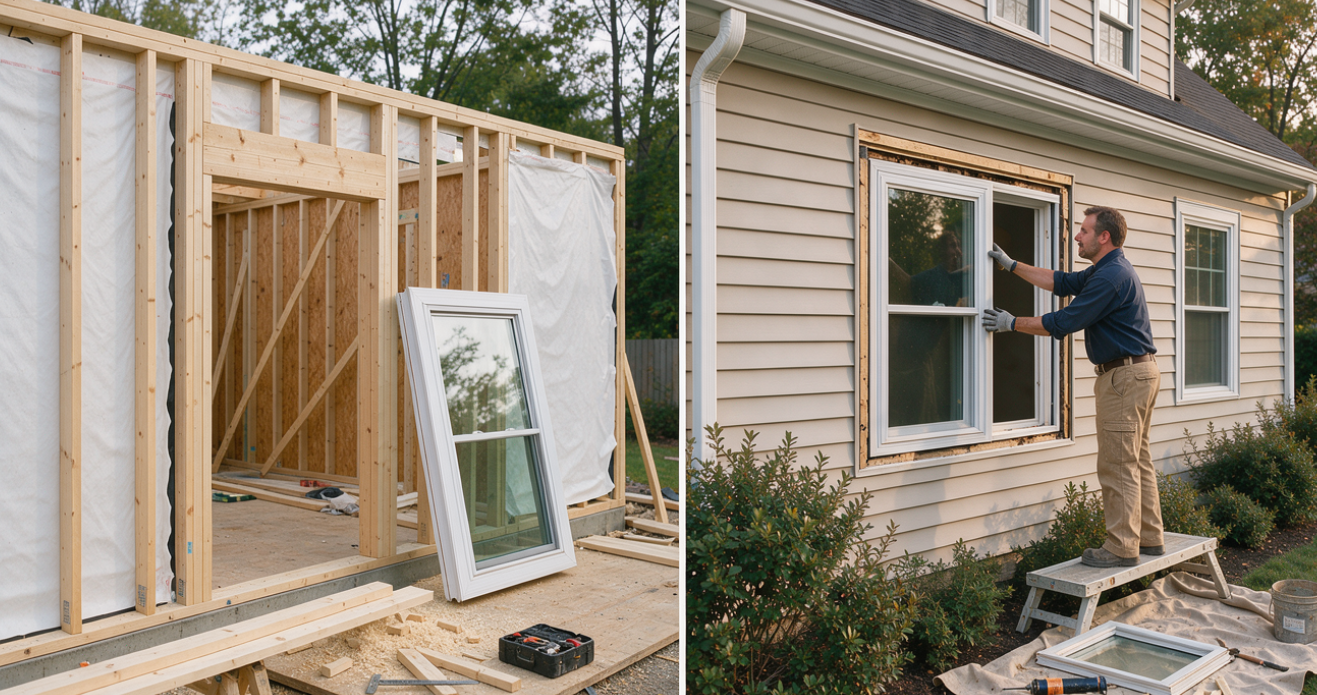
New construction lets you set window size, placement, and orientation before framing. Replacement usually works within existing openings. The distinction changes your design freedom, your installation method, and which rebates you qualify for, since many retrofit programs exclude new construction entirely.
When choosing windows for a new home, there’s more to consider than frame color or whether to choose double- or triple-pane glass. Window size, placement, insulation, ventilation, and installation all influence how comfortable and energy-efficient your home will be.
One important distinction homeowners often overlook is that choosing windows for new construction is different from replacing windows in an existing home.
With a new build, you can plan window placement around the home’s layout, orientation, and energy needs. In an older house, you first need to assess the condition of existing frames, openings, and surrounding walls.
The differences extend to project costs and financial incentives. While homeowners replacing existing windows may qualify for energy-efficiency rebates, which can be estimated using a rebate calculator, many retrofit incentive programs exclude new construction.
Understanding these differences can help you avoid costly design changes, make better use of your budget, and choose windows that will perform reliably for years to come.
New Construction vs. Replacement Windows: What’s Actually Different?
The main difference is how much flexibility you have before you start installing windows.
In new construction, you can match window sizes and locations with the framing, exterior finishes, roof overhangs, and room layouts. In an existing home, replacements usually fit into the current openings unless you’re ready for extra structural and finishing work.
| Consideration | New construction | Residential window replacement |
|---|---|---|
| Window size | Planned around the building design | Usually determined by existing openings |
| Placement | Can be adjusted before framing | Relocation requires additional construction |
| Installation | Integrated with new framing and wall barriers | Depends on insert or full-frame installation |
| Energy efficiency | Selected alongside the building’s energy design | Helps address older or poorly performing windows |
| Design flexibility | Greater freedom in size, shape, and location | Limited unless openings are modified |
| Project cost | Coordinated with the construction budget | Includes removal, potential repairs, and finishing |
The terms “new-construction window” and “replacement window” mainly refer to how they’re installed, not to differences in glass performance.
New-construction windows commonly use a nailing fin for attachment and integration with the new wall assembly. Insert replacements fit within an existing frame that remains in suitable condition. Full-frame replacement removes the old frame, allowing the surrounding opening and installation details to be addressed more extensively.
A full-frame replacement can be similar to a new-construction installation, even if the house is many years old.
| Installation method | What it involves | When it fits |
|---|---|---|
| New construction, nailing fin | Window fastens to the framing and integrates with the wall’s water-resistive barrier and flashing | New builds, additions, and newly framed openings |
| Insert replacement | New unit fits inside the existing frame, which stays in place | Frames and surrounding structure are sound and dry |
| Full-frame replacement | Old frame comes out, exposing the rough opening for repair and proper flashing | Damaged frames, moisture behind trim, or sizing changes |
Plan Window Size and Placement Before Framing Begins
One big advantage of new construction is being able to choose where your windows go before the walls go up.
Don’t just focus on how the windows look from outside. Where you place them affects natural light, privacy, furniture layout, ventilation, and how much heating or cooling you’ll need throughout the year.
Think about which way each window will face. For example, south-facing windows let in helpful winter sunlight, but big west-facing windows can bring in too much afternoon heat in the summer.
A Real Use-Case: A New Home With Large West-Facing Windows
Picture a living room with floor-to-ceiling windows that show off a beautiful sunset. The view is a big plus, but the room might also get a lot of strong afternoon sun.
Before finalizing the drawings, the builder and homeowner could evaluate:
- Window size and the total glass area.
- Solar heat gain coefficient (SHGC) appropriate for the climate.
- Exterior shading, screens, or other solar-control features.
- Roof overhangs and their effectiveness at different sun angles.
- Whether the room needs operable windows for ventilation.
It’s easier to make design changes before framing than to fix overheating problems after the house is finished.
In an existing home, changing where windows are placed is harder because it can mean changing the structure, exterior, interior finishes, and getting permits.
Double-Pane vs. Triple-Pane: Are You Paying for Performance You Don’t Need?
Triple-pane windows are often marketed as the best choice for new construction. However, a well-designed double-pane window may deliver sufficient performance at a lower cost, depending on the climate, insulation, airtightness, and overall building design.
Before paying for a third pane, compare the home’s actual energy requirements with the window’s U-factor and solar heat gain coefficient (SHGC).
The two numbers, in plain terms: U-factor measures how readily heat passes through the window, so a lower number insulates better. SHGC measures how much solar heat the glass lets in, on a scale of 0 to 1, so a lower number blocks more summer heat. Cold climates lean on U-factor. Cooling-dominated climates and west-facing glass lean on SHGC.
ENERGY STAR Window Performance Standards: U.S. vs. Canada
| Region | Maximum U-factor | SHGC requirement |
|---|---|---|
| U.S. Northern | 0.22 | 0.17 or higher |
| U.S. North-Central | 0.25 | 0.40 or lower |
| U.S. South-Central | 0.28 | 0.23 or lower |
| U.S. Southern | 0.32 | 0.23 or lower |
| Canada (nationwide) | 1.22 W/m2K (about 0.21 U.S.) | No fixed national SHGC limit |
Notice that the Northern U.S. requirement sets a minimum SHGC rather than a maximum. In heating-dominated climates, some solar gain is a benefit to capture, not a problem to block. Southern zones invert that logic entirely.
The comparison shows why triple glazing should be evaluated, not automatically specified. It can be especially valuable in cold climates, near large glass areas, or where improved condensation resistance and thermal comfort are priorities.
For summer overheating, SHGC is often more relevant than pane count. For example, an SHGC of 0.23 admits less solar heat than 0.40 under equivalent conditions, regardless of whether the window has two or three panes.
Moreover, Manitoba Hydro Window Rebate also states that the better investment is the window that meets the project’s comfort and efficiency targets, not necessarily the one with the most glass.
How Rebates Change the Math
Incentive rules can override a purely technical comparison, which is why they belong in the decision rather than after it.
Efficiency Manitoba’s windows and doors rebate is a useful example of how specific the terms get. It pays $100 for each eligible window or door, counted by rough opening, and the program requires ENERGY STAR certified products with at least triple-pane glass. Applications need an NRCan reference number from the invoice and must be submitted within 90 days of installation and final payment. The home must be a primary residence.
Two details matter most for this article’s purpose. The product must replace an existing window or door between a heated and an unheated space, so windows in newly created openings do not qualify. And because the rebate requires triple-pane glass, a program like this can tip a borderline double-versus-triple decision on its own.
| Incentive | Status and terms | New construction? |
|---|---|---|
| Efficiency Manitoba windows and doors rebate | $100 per eligible rough opening, ENERGY STAR with triple-pane glass, NRCan reference number, 90-day application window, primary residence only | Not eligible for new openings |
| U.S. federal 25C credit | Previously 30 percent of cost with a $1,200 annual cap shared across windows, doors, insulation, and audits. Repealed by the One Big Beautiful Bill Act for property placed in service after December 31, 2025 | Was retrofit-focused; no longer available for 2026 work |
| Utility and provincial programs | Vary widely by provider, with their own certification tiers, caps, and deadlines | Usually retrofit only |
With the U.S. federal credit now closed for work placed in service in 2026 and later, utility and provincial programs are the main incentive route for most homeowners. Confirm current terms with your own provider before ordering, since caps and eligible product lists change between program years.
Installation Details Matter as Much as the Window Itself
Even the best window won’t work well if water or air leaks in around where it’s installed.
In new construction, the window must be integrated with the wall’s water-resistive barrier, flashing, sill protection, and air-sealing system. Properly designed drainage details help direct incidental water outward rather than into the wall cavity.
The DOE’s Building Science Education guidance emphasizes properly lapped flashing and integration with the wall’s drainage plane.
When replacing windows, you also need to check the condition of the current opening.
A Real Use-Case: Replacing Windows in a 25-Year-Old House
Consider a house with some drafty windows, one with foggy glass between the panes, and another spot showing water stains.
If the frames and surrounding structure are sound, an insert replacement may be appropriate for some openings.
But if a frame is damaged or there’s moisture behind the trim, you may need a full-frame replacement to find and fix the real problem.
If you pick an insert just because it’s cheaper to install, you might miss hidden damage.
The best approach is to check each window opening before you order. Full-frame replacements can cost more, but they let you fix problems that inserts can’t reach.
No single installation method is always best. The right choice depends on your home’s construction, the condition of the openings, window design, and what’s required for installation.
Where Should You Spend More, and Where Can You Save?
Window costs can add up fast if you choose premium glass, big openings, special shapes, custom finishes, or complex installation details. It’s best to spend more where the upgrade really makes a difference.
Homeowners need to prioritize:
- Certified energy performance appropriate for the climate.
- Window sizes and operating styles that suit the rooms.
- Reliable installation, flashing, and air sealing.
- Durable hardware and materials suited to local exposure.
- Proper sizing, safety glazing, and code compliance where required.
Be selective with extras like decorative grids, unusual shapes, fancy finishes, and big glass areas.
For new builds, make window decisions early and coordinate them with framing and exterior design. Even a small change in window size can affect the structure, installation, shading, and interior finishes.
For replacements, ask contractors to separate the cost of the windows from installation, removal, repairs, and finishing. A lower quote might not cover everything.
Homeowners planning an addition can also use RoofPitch’s Home Addition Cost Calculator to consider how window choices fit within the larger construction budget.
What Windows Actually Cost
National survey figures give a useful starting point, though material, size, and installation method move the number considerably.
| Item | Typical 2026 figure |
|---|---|
| Average cost per window, installed | $517 |
| Average project, about 7 windows | Roughly $7,200 |
| Double-pane, per window | About $529 |
| Triple-pane, per window | About $609 |
| Triple-pane premium | About $80 per window |
| Insert vs. full-frame | Inserts generally cost less; full-frame adds trim, framing, and finishing labor |
That $80 per window gap is worth holding alongside the rebate terms above. Where a program pays $100 per opening and requires triple-pane, the upgrade can effectively pay for itself. Where no such program applies and the climate does not demand it, the same $80 may be better spent on installation quality or a more suitable SHGC.
Make the Window Decision at the Right Stage
With new construction, you can plan window placement, size, and performance before anything is built. In existing homes, you need to start by checking the condition of the windows, frames, and surrounding structure.
In both cases, the best windows have the right energy ratings, work well for your needs, use good materials, and are installed properly.
Before you order, make the choices that are hard to change later, check the performance ratings, and be sure the installation method fits your home.
A good window does more than just look good on paper. It should keep giving you comfort, daylight, fresh air, and reliable performance for years after your home is built.
Frequently Asked Questions
What is the difference between new construction and replacement windows?
The terms describe how the window is installed, not how the glass performs. New-construction windows typically use a nailing fin that fastens to the framing and integrates with the wall’s water-resistive barrier. Replacement windows fit an existing opening, either as an insert inside the old frame or as a full-frame installation after the old frame is removed.
Do I need triple-pane windows?
Not always. A well-designed double-pane window can deliver sufficient performance at lower cost depending on climate, insulation, airtightness, and glass area. Triple glazing is most valuable in cold climates, with large glass areas, or where condensation resistance and thermal comfort are priorities. Some rebate programs require it, which can change the decision.
What is the difference between U-factor and SHGC?
U-factor measures how readily heat passes through the window, so a lower number insulates better. SHGC measures how much solar heat the glass admits on a scale of 0 to 1, so a lower number blocks more summer heat. Cold climates lean on U-factor, while cooling-dominated climates and west-facing glass lean on SHGC.
What ENERGY STAR ratings do windows need?
It depends on the region. In the U.S., the Northern zone allows a maximum U-factor of 0.22 with an SHGC of 0.17 or higher, North-Central is 0.25 with SHGC of 0.40 or lower, South-Central is 0.28 with 0.23 or lower, and Southern is 0.32 with 0.23 or lower. Canada’s nationwide requirement is a U-factor of 1.22 W/m2K, roughly 0.21 in U.S. units, with no fixed national SHGC limit.
Why does window orientation matter so much?
Orientation determines daylight, heat gain, ventilation, and privacy, and it is the one window decision that cannot be upgraded later. South-facing glass admits useful winter sun and can be shaded by overhangs, while large west-facing glass takes a low afternoon sun angle that is much harder to control.
Can I get a rebate for windows in a new home?
Usually not. Many retrofit incentive programs require that the product replace an existing window or door between a heated and an unheated space, so windows in newly created openings are excluded. Efficiency Manitoba’s windows and doors rebate works this way.
Is the federal window tax credit still available?
No. The 25C Energy Efficient Home Improvement Credit was repealed by the One Big Beautiful Bill Act for property placed in service after December 31, 2025. It previously covered 30 percent of cost with a $1,200 annual cap shared across windows, doors, insulation, and home energy audits. Utility and provincial programs are now the main incentive route.
Should I choose an insert or a full-frame replacement?
Check each opening before ordering. If the frame and surrounding structure are sound and dry, an insert may be appropriate. If a frame is damaged or there is moisture behind the trim, a full-frame replacement exposes the rough opening so the real problem can be found and fixed. One house can need both methods.
How much do new windows cost?
Recent survey data puts the average installed cost at about $517 per window, with a typical seven-window project around $7,200. Double-pane averages about $529 per window and triple-pane about $609, a difference of roughly $80. Full-frame replacement adds trim, framing, and finishing labor.
What should I prioritize if my window budget is tight?
Certified energy performance suited to your climate, window sizes and operating styles that fit the rooms, reliable installation with proper flashing and air sealing, durable hardware for local exposure, and code compliance including safety glazing. Be selective with decorative grids, unusual shapes, custom finishes, and oversized glass areas.
Sources
- ENERGY STAR residential window performance criteria for U.S. climate zones and Canada
- Efficiency Manitoba, Windows and Doors Rebate program terms (rebate amount, triple-pane requirement, NRCan reference number, 90-day window, new-opening exclusion)
- U.S. Department of Energy, Building Science Education guidance on window flashing and drainage-plane integration
- This Old House, Window Replacement Cost 2026 (per-window averages, double-pane and triple-pane pricing, insert versus full-frame)
- Reporting on the One Big Beautiful Bill Act’s repeal of the 25C Energy Efficient Home Improvement Credit for property placed in service after December 31, 2025
Disclaimer: Costs, performance criteria, and incentive details in this guide are 2026 estimates compiled from published industry, government, and utility sources for planning purposes only. Rebate terms, caps, eligible product lists, and tax rules change between program years and vary by location. Confirm current requirements with your utility, program administrator, or tax advisor, and get written quotes from licensed installers before ordering.