
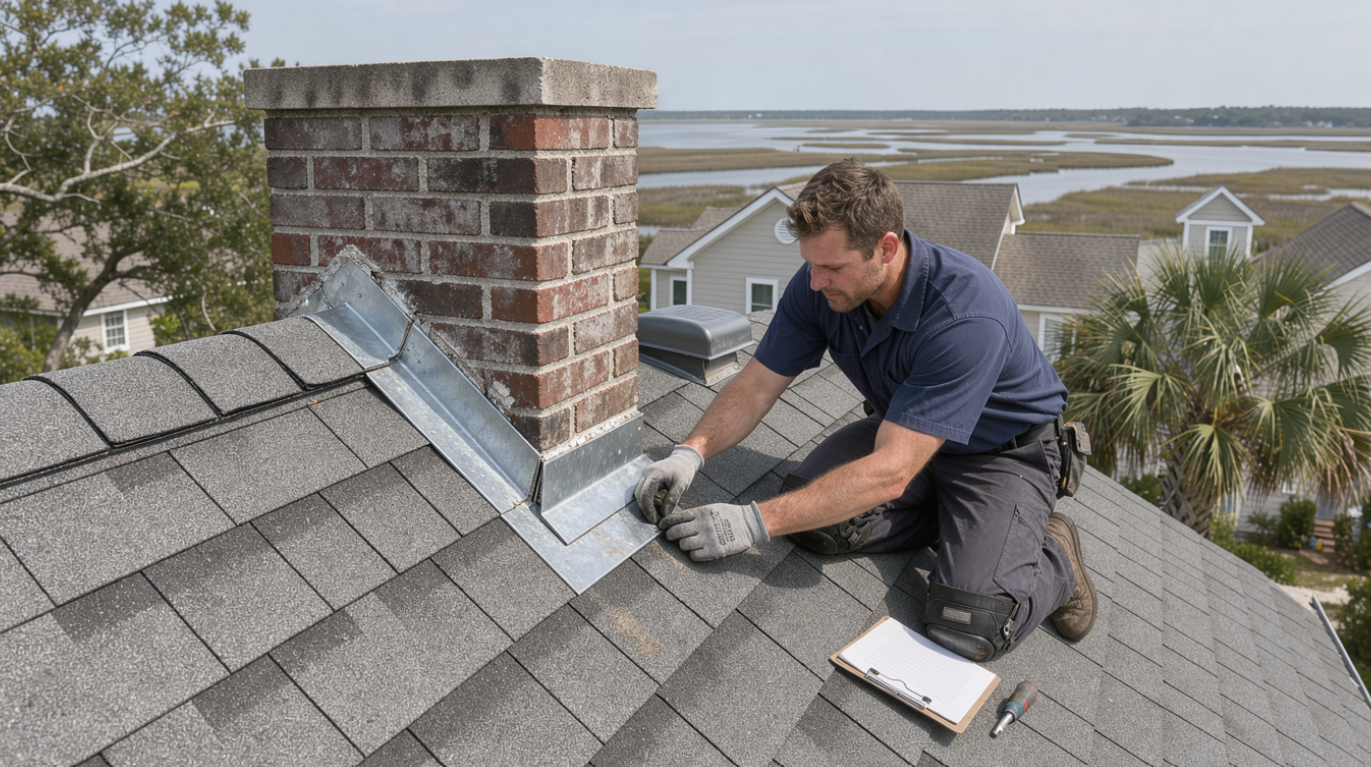
A roof tune-up is scheduled preventive maintenance: a close inspection of flashing, fasteners, shingle seals, drainage, and attic ventilation, with small fixes made on the spot. It matters more in Wilmington because salt air can cut the service life of standard roof metal by 30 to 50 percent, and the components it attacks first are the ones a ground-level look never reaches.
“Do I really need a roof inspection if there’s no leak?” is a question a lot of homeowners quietly wonder but rarely search in those exact words, usually showing up instead as “roof maintenance checklist” or “how to extend roof life.”
For a coastal property in Wilmington, the honest answer is yes, and understanding what a genuine roof tune-up actually involves explains why.
Why “No Active Leak” Doesn’t Mean “No Problem”
A roof can be developing real, costly issues long before water actually reaches your ceiling.
Salt air corrodes exposed fasteners and flashing gradually, a loosened shingle seal can sit unnoticed for months, and minor granule loss from UV exposure compounds slowly rather than announcing itself all at once.
A tune-up is specifically designed to catch these developing issues while they’re still inexpensive, targeted fixes, rather than waiting for them to become an active leak.
Wilmington’s climate gives that slow deterioration plenty to work with. The area averages about 58 inches of rain across roughly 119 rainy days a year, with July highs near 90 degrees and summer humidity that sits heavy from June through September. That combination of moisture, heat, and salt keeps working on a roof every month of the year, whether or not anything is leaking.
What a Thorough Tune-Up Should Actually Cover
A genuine tune-up goes well beyond a glance from the ground. It should include a close inspection of flashing around every chimney, vent, and skylight, since these transition points are where coastal corrosion and general wear show up first.
It should check the condition of exposed fasteners and metal hardware for early signs of salt-driven corrosion, confirm shingles are still properly sealed at the edges and haven’t begun lifting from wind exposure, and verify that gutters and drainage are functioning properly rather than allowing water to sit against the roofline.
| What gets checked | What the technician is looking for | Why it matters here |
|---|---|---|
| Flashing at chimneys, vents, skylights | Rust staining, lifted laps, failed sealant, pinholes | Transition points corrode first in salt air |
| Exposed fasteners and hardware | Surface rust, backed-out nails, degraded washers | Standard galvanized hardware fails years early near the coast |
| Shingle seal and edges | Lifting tabs, broken adhesive strips, wind creasing | A broken seal is invisible from the ground and invites the next storm in |
| Granule condition | Bare spots, granules collecting in gutters | UV and heat accelerate loss in this climate |
| Pipe boots and penetrations | Cracked rubber collars, failed clamps | Rubber boots are a common early failure point on the coast |
| Gutters and drainage | Blockages, sagging, standing water at the roofline | Heavy coastal rainfall overwhelms marginal drainage fast |
| Attic ventilation | Blocked intake, unbalanced exhaust, moisture signs on sheathing | Trapped humidity deteriorates the deck from underneath |
Why Coastal Exposure Changes What Actually Needs the Closest Attention
Inland roofing maintenance tends to focus heavily on general wear and storm damage.
A Wilmington property adds a layer most checklists don’t account for: metal components exposed to sustained salt-laden air corrode measurably faster than the same components would further inland.
A thorough tune-up here specifically checks fastener and flashing condition as a priority, not an afterthought, since that’s exactly where this climate’s particular wear pattern shows up first.
How Fast Salt Air Actually Works
The general principle is easy to accept in the abstract. The specific numbers are what make the case for a scheduled tune-up rather than an occasional one.
Coastal exposure can cut the service life of standard roof components by 30 to 50 percent compared with the same parts installed inland. A galvanized nail that would last 25 years or more inland can show rust within 3 to 5 years on a beachfront home.
| Component | Typical beachfront service life |
|---|---|
| Electro-galvanized nails | 2 – 3 years |
| Galvanized steel flashing | 3 – 7 years |
| Hot-dipped galvanized nails | 5 – 10 years |
| Steel gutters | 5 – 10 years in the salt zone |
| Neoprene washers on exposed-fastener panels | 7 – 12 years |
| Rubber (EPDM) pipe boots | 10 – 15 years |
| Stainless steel (types 304 and 316), PVDF-coated panels | Substantially longer |
That timeline is the practical argument for scheduling. A fastener that corrodes through in year three on a thirty-year roof is not a roof failure, it is a maintenance item, as long as somebody is looking for it.
How Far Inland Salt Air Reaches
Salt exposure is not a simple on-off condition at the waterline. It grades down with distance, and knowing roughly where your home sits helps set a sensible inspection interval.
The point worth noting for Wilmington specifically is that “coastal” is not limited to oceanfront addresses. Homes along the Cape Fear River and the Intracoastal Waterway sit in brackish-air exposure too, well back from the surf line.
Why Timing a Tune-Up Around Storm Season Makes Practical Sense
Scheduling a tune-up before hurricane season ramps up gives you a clear picture of your roof’s actual condition heading into the months when it’s most likely to be tested by real wind and rain.
A tune-up after a significant storm, even one that didn’t cause obvious damage, is equally worth considering, since wind can compromise a shingle seal without necessarily tearing anything off outright.
The local frequency makes the case on its own. Wilmington has been brushed or hit by a tropical system 95 times across the 154 years from 1871 through 2025, which works out to roughly once every 1.62 years. Atlantic hurricane season runs June 1 through November 30.
Why This Is Different From a Full Inspection After Suspected Damage
A storm damage inspection is reactive, triggered by a specific event and focused on identifying damage from that event.
A tune-up is proactive maintenance, performed on a regular schedule regardless of whether anything specific prompted it, aimed at catching the slow, cumulative wear this coastal climate produces before it becomes a bigger problem.
| Roof tune-up | Storm damage inspection | |
|---|---|---|
| What prompts it | A schedule | A specific storm or suspected damage |
| What it looks for | Slow, cumulative wear: corrosion, seal failure, drainage, ventilation | Damage attributable to one dated event |
| Typical outcome | Small targeted fixes made during or shortly after the visit | A documented damage report, often for an insurance claim |
| Timing | Before and after storm season | As soon as possible after the event |
| Who it serves | Your maintenance budget | Your claim file |
They are complementary rather than interchangeable. A tune-up record also helps a later claim, because documented maintenance history makes it easier to show that damage came from a storm rather than from years of neglect.
Why Attic Ventilation Deserves a Look During the Same Visit
A thorough tune-up often includes checking attic ventilation alongside the exterior roof surface, since inadequate airflow traps heat and humidity against the underside of the roof deck.
In a humid coastal climate, this trapped moisture can accelerate deck deterioration from underneath, a problem that’s completely invisible from a surface-level roof inspection alone but that a comprehensive tune-up should still account for.
Wilmington’s long humid stretch from June through September is precisely when that matters most, and it overlaps almost exactly with hurricane season. A roof deck already softened from below has less margin when a storm arrives.
What a Tune-Up Costs
Pricing varies by roof size, pitch, access, and how much of the visit is inspection versus minor repair. National inspection figures give a reasonable frame of reference.
| Service | Typical 2026 cost |
|---|---|
| Roof inspection, national average | About $257 |
| What most homeowners pay | $125 – $392 |
| Southeast region range | About $190 – $200 |
| Physical walk-on inspection | $75 – $200 |
| Drone inspection | $150 – $400 |
| Infrared inspection | $400 – $600 |
| Attic inspection add-on | $200 – $500 |
| Roof certification | $150 – $200 |
Many contractors bundle a tune-up as inspection plus a set allowance of minor repairs, so ask what the quoted price actually includes. You can sanity-check a quote with our roof inspection cost calculator, or measure your roof first with the roof square footage calculator.
What to Ask Before Scheduling One
A few questions clarify what you’re actually getting:
- Does this service include a close inspection of flashing and fasteners specifically, not just a general visual check?
- Will I receive a written report of what was found, including photos?
- How does this differ from your storm damage inspection, and which one actually fits what I need right now?
- Does the price include minor repairs, or are those quoted separately afterward?
- Will the technician walk the roof, or is this a drone or ground-level assessment?
- Do you check attic ventilation as part of the same visit?
Why Skipping This Costs More Than the Service Itself
A fastener or flashing detail that’s allowed to corrode fully, rather than being caught and addressed early, often means replacing a larger section than would have been necessary with earlier attention.
Given how affordable a routine tune-up is relative to an emergency repair, this is one of the more straightforward cost-saving decisions a coastal homeowner can make.
Getting Maintenance That Actually Accounts for This Climate
Because sustained salt air exposure creates a specific wear pattern that a generic maintenance checklist doesn’t fully address, it’s worth confirming that whoever performs your tune-up treats coastal-specific details, flashing, fasteners, and drainage as a genuine priority.
A Wilmington NC roofing contractor offering this kind of maintenance service, built specifically around what this coastline actually does to a roof, helps your investment last as long as it’s genuinely capable of lasting.
Frequently Asked Questions
Do I need a roof inspection if there is no leak?
Yes, especially on the coast. Salt air corrodes fasteners and flashing gradually, shingle seals can break without anything tearing off, and granule loss compounds slowly. A tune-up is built to catch those while they are still small, targeted fixes rather than active leaks.
What is the difference between a roof tune-up and a roof inspection?
A tune-up is scheduled preventive maintenance that includes a close inspection plus minor repairs. A storm damage inspection is reactive, triggered by a specific event and focused on documenting damage from it, often for an insurance claim. The two serve different purposes and complement each other.
What should a roof tune-up include?
Close inspection of flashing at every chimney, vent, and skylight; the condition of exposed fasteners and metal hardware; shingle seal and edge condition; granule loss; pipe boots and penetrations; gutters and drainage; and attic ventilation. A written report with photos should come with it.
How much faster does salt air damage a roof?
Coastal exposure can cut the service life of standard roof components by 30 to 50 percent compared with inland installations. A galvanized nail that would last 25 years or more inland can show rust within 3 to 5 years on a beachfront home.
Which roof parts fail first near the ocean?
Small metal components. Electro-galvanized nails commonly last only 2 to 3 years beachfront, galvanized steel flashing 3 to 7 years, hot-dipped galvanized nails and steel gutters 5 to 10 years, neoprene washers 7 to 12 years, and EPDM pipe boots 10 to 15 years. Stainless types 304 and 316 and PVDF-coated panels last substantially longer.
How far inland does salt air affect a roof?
Salt effects are commonly described as reaching about three miles inland. Damage is most severe within 1,500 feet of the water, moderate from 1,500 feet to a mile, lighter from one to three miles, and negligible beyond that. In Wilmington, homes along the Cape Fear River and the Intracoastal Waterway face brackish-air exposure as well.
How often should a coastal roof be inspected?
Common guidance is twice a year within three miles of the water and three times a year within 1,500 feet of the waterline, plus a check after every significant storm. Inland homes in milder conditions can often go every year or two.
When is the best time to schedule a tune-up in Wilmington?
Spring, before Atlantic hurricane season opens on June 1, so you head into the risk window knowing the roof’s condition. A second check after the season closes on November 30 is worthwhile, along with a look after any significant storm.
How much does a roof tune-up or inspection cost?
Roof inspections average about $257 nationally, with most homeowners paying $125 to $392 and Southeast pricing around $190 to $200. A walk-on physical inspection runs $75 to $200, drone $150 to $400, and infrared $400 to $600. An attic inspection add-on runs $200 to $500. Ask whether minor repairs are included in a tune-up price.
Why does attic ventilation matter for roof maintenance?
Inadequate airflow traps heat and humidity against the underside of the roof deck. In a humid coastal climate that moisture can deteriorate the deck from below, which a surface-only inspection cannot detect. Wilmington’s most humid months, June through September, overlap almost exactly with hurricane season.
Free Roofing Calculators
Sources
- Weather Shield Roofers, Salt Air Roof Damage coastal guide 2026 (component service life, 30 to 50 percent lifespan reduction, salt reach by distance, inspection frequency)
- Angi, How Much Does a Roof Inspection Cost 2026 (national average, inspection types, regional ranges, attic add-on, frequency guidance)
- HurricaneCity, Wilmington NC tropical system history (95 events from 1871 through 2025, average interval)
- BestPlaces, Wilmington NC climate data (annual rainfall, rainy days, July high, humid months)
- National Hurricane Center, Atlantic hurricane season dates
Disclaimer: Costs, component service-life figures, and climate data in this guide are 2026 estimates compiled from published contractor, industry, and climate sources for planning purposes only. Actual corrosion rates vary with distance from salt water, prevailing wind, roof design, and material grade. Get a written assessment from a licensed, insured roofing contractor for your specific property.