
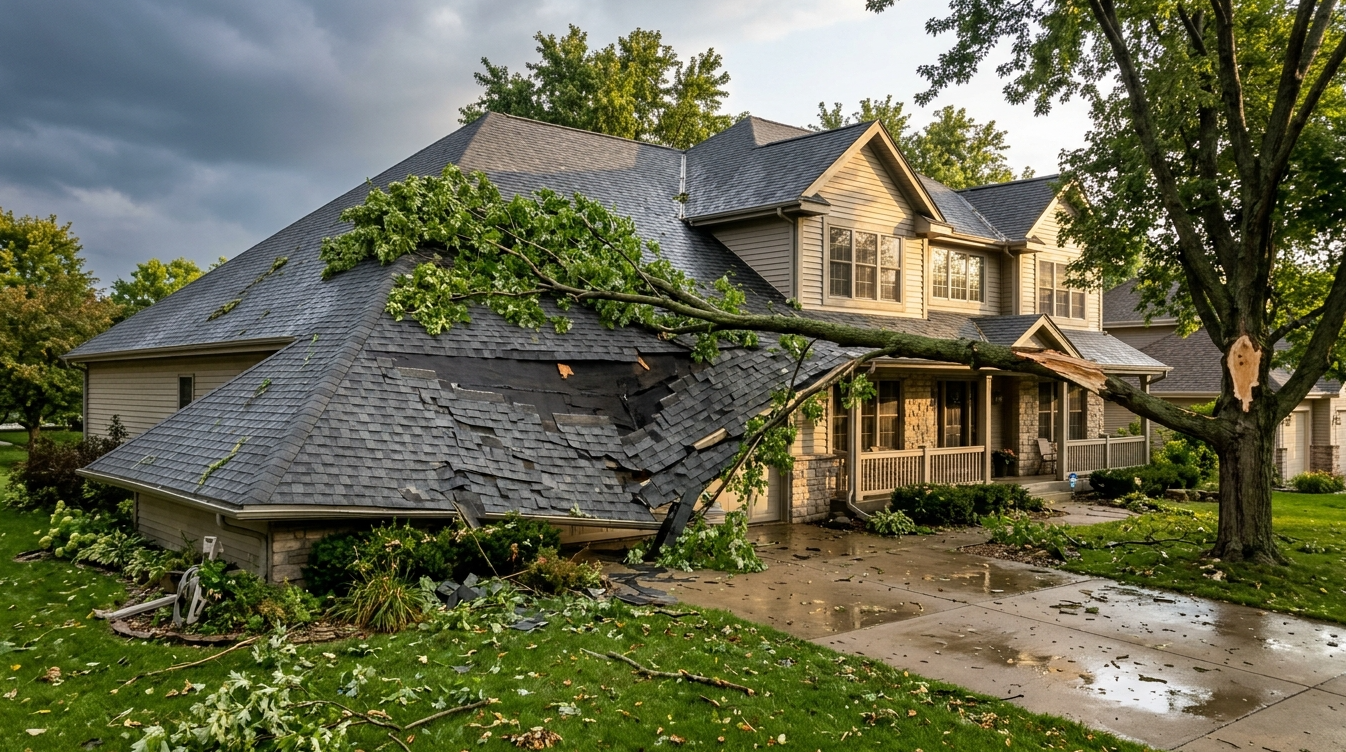
Triage by what you are actually looking at. Active dripping, daylight through the deck, a limb on the roof, or a whole slope of missing shingles are same-night calls. A small, slow stain can wait for morning. In freezing weather, expect a temporary fix now and the permanent repair when temperatures allow, because most shingle sealants and self-seal strips need 40 degrees or more to bond.
Central Indiana storms like to travel in clusters, which is why the first hour after damage matters less than the first day, and why a calm decision beats a panicked one.
Here’s a triage guide organized by what you’re actually looking at.
Triage at a Glance
If you only read one thing before calling, read this. The right response depends less on how alarming the damage looks than on whether water is actively entering and whether the structure is exposed.
| What you are looking at | How fast to act | First move |
|---|---|---|
| Limb or tree resting on the roof | Same night | Stay out of the room below; photograph from the ground |
| Active dripping or a bulging ceiling | Same night | Contain water, kill power to nearby circuits |
| Daylight visible through the deck | Same night | Call for a temporary cover |
| Missing shingles across a whole slope | Same night | Call for a temporary cover before the next storm |
| A few missing shingles, no water inside | Same day or next morning | Check the attic for daylight or damp insulation |
| January leak with ice at the eaves | Same day | Rake snow off the lower roof from the ground |
| Hail with no leak | Within days | Document dents on gutters, vents, and screens |
| Small, slow stain, not spreading | Next business day | Photograph it with a date, mark its edge in pencil |
Scenario 1: A Limb or Tree Is on the Roof
Do now: Stay inside, away from the area below the limb. If there’s a hole, move belongings out of the room and place buckets under drips. Photograph the damage from the ground.
Don’t: Climb up to drag it off. Branches can be load-bearing in a way you can’t see, and wet roofs are slick. Don’t cut a limb that’s touching a power line.
Call: A roofer for emergency stabilization, and a tree service if the limb is large. If a line is involved, call the utility first.
Scenario 2: Active Water Coming Through the Ceiling
Do now: Contain it. Move furniture, put out buckets, and if the ceiling is bulging, puncture the lowest point carefully to release water in a controlled way. Turn off power to any circuit where water is near fixtures.
Don’t: Ignore it because the stain looks small. Water travels along framing, and the stain is often several feet from the entry point.
Call: An emergency crew the same night. Someone should tarp or temporarily patch the opening so the structure stays dry until permanent work can happen.
Scenario 3: Missing Shingles After Wind
Do now: Check from the ground for exposed felt or bare decking, and look in the attic for daylight or damp insulation.
Don’t: Assume a missing patch is only cosmetic. Bare underlayment doesn’t last long in rain.
Call: A roofer the same day or the next morning if water isn’t coming in yet. If the next storm is close, ask for a temporary cover.
Scenario 4: A January Leak With Ice at the Eaves
Winter emergencies have different rules. Ice dams form when heat escaping into the attic melts the snow on the upper roof while the eaves stay frozen, trapping meltwater behind a ridge of ice that backs up under shingles.
Do now: Pull snow off the lower roof from the ground with a roof rake. Place buckets under leaks. Open attic hatches carefully to check for water on insulation.
Don’t: Chip ice with a hammer or shovel, which damages shingles. Don’t use a torch or heat gun.
Call: A professional for safe ice removal, and ask about the underlying insulation and ventilation problem.
Cold-weather reality: Shingles typically won’t seal properly in freezing temperatures. In winter, expect a temporary fix, such as a tarp, sealant, or patch, with the permanent repair scheduled for milder weather.
Two details worth knowing when a crew gives you the winter answer. Factory self-seal strips need warmth and direct sun to activate, so shingles installed cold may not bond until spring, which is why manufacturers require hand-sealing with dabs of roof cement in cold weather. And the limits vary by product rather than following one universal cutoff: some wet-patch cements work down to about 20 degrees, ice and water shield generally wants 40 degrees or higher, and certain roof cements call for 45 degrees and rising. Ask which product the crew is using and what its labeled minimum is.
Scenario 5: Hail, But No Obvious Leak
Do now: Look for dented gutters, dinged vents, and granules in the downspouts. Check window screens and siding for dents.
Don’t: Conclude the roof is fine because it isn’t leaking. Hail can bruise shingles in ways that show up months later.
Call: For an inspection within days, not weeks.
There is a second reason not to wait. Most policies run the claim clock from the date of loss rather than the date you noticed damage, and filing windows vary by carrier. An inspection within days gives you a dated record tied to a verifiable storm while the evidence on the gutters and screens is still fresh.
When Emergency Service Is Worth Calling
Not every problem needs a midnight call. A slow, small stain in a bedroom can usually wait until morning. Active dripping, daylight through the deck, a limb resting on the roof, or missing shingles across a whole slope shouldn’t. If you’re not sure, call.
A short phone assessment costs far less than a soaked subfloor. When you need emergency roof repair in Indianapolis, look for a company that answers after hours, anchors temporary covers properly, and photographs everything before leaving.
Indiana’s storm frequency is part of why that after-hours question matters. The state averages about 22 tornadoes a year, and severe thunderstorm wind is far more common than that figure suggests. When a line of storms moves through Central Indiana, every roofer in the metro gets called the same evening, and the company that answers is often the one that already has your file.
What an Emergency Call Actually Costs
Knowing the range makes the decision easier at 10 p.m., and it keeps a legitimate after-hours premium from reading as opportunism.
| Service | Typical cost |
|---|---|
| Emergency call-out fee | $200 – $500 |
| After-hours labor premium | Add 50 to 100 percent |
| Same-day response premium | $100 – $300 on top of the repair |
| Minor emergency leak repair | $150 – $400 |
| Professional tarping | $200 – $1,500 |
| Emergency patch or sealant | $300 – $800 |
| Storm damage stabilization | $500 – $5,000 |
| Tree removal from a roof | $1,500 – $4,000 |
| Full emergency repair, major damage | $5,000 – $15,000+ |
Most emergencies land between about $250 and $3,200. Two practical notes: save receipts for tarps, plastic sheeting, and other mitigation supplies, since policies commonly cover reasonable steps taken to prevent further damage, and treat a tarp as a 90-day outside limit rather than a solution. Anchored properly it buys you time to schedule real work; left in place through a season it becomes its own problem.
What a Good Emergency Visit Looks Like
- The crew finds the entry point, which is often uphill from the stain.
- They secure a tarp or temporary patch so it won’t blow off in the next gust.
- They photograph the damage and explain what they found.
- They give you a written plan and price for the permanent repair, without pressuring you to sign on the spot.
That last point deserves emphasis after a regional storm, when unfamiliar companies canvass neighborhoods with urgent pitches. A legitimate emergency visit stabilizes the roof and leaves you with documentation and a quote. A contract demanded on the spot, an offer to waive your deductible, or a request to sign over your insurance claim are all reasons to stop and get a second opinion in daylight.
Build a Storm Kit Now
- A roll of heavy plastic sheeting and a few five-gallon buckets
- A flashlight and a battery power bank
- Your roofer’s phone number and your insurance policy number written down
- A phone folder with dated photos of your roof and attic in good condition
- A roof rake if you live in snow country
The dated photo folder is the item people skip and later wish they had. Before-and-after images are what separate storm damage from pre-existing wear when a claim is reviewed, and they take ten minutes to capture on a clear afternoon.
The best time to learn your roof’s weak spots is before the second storm arrives. A few minutes of preparation turns an emergency into a manageable repair.
Frequently Asked Questions
When is a roof leak an actual emergency?
When water is actively dripping, a ceiling is bulging, daylight is visible through the deck, a limb is resting on the roof, or shingles are missing across a whole slope. A small, slow stain that is not spreading can usually wait until the next business day. If you are unsure, a phone assessment costs nothing compared with a soaked subfloor.
Should I go on the roof to remove a fallen limb?
No. Branches can be load-bearing in ways that are not visible from below, and wet roofs are slick. Never cut a limb that is touching a power line. Call the utility first if a line is involved, then a roofer for stabilization and a tree service if the limb is large.
Should I puncture a bulging ceiling?
Carefully, at the lowest point, to release trapped water in a controlled way rather than letting it collapse unpredictably. Move furniture first, put buckets underneath, and turn off power to any circuit where water is near fixtures.
Why is the ceiling stain not under the leak?
Water travels along framing before it finds a gap to exit through, so the stain is often several feet from the entry point. A good emergency crew locates the entry point, which is usually uphill from the stain, rather than patching above the visible damage.
Can a roof be repaired in freezing weather?
Temporarily, yes. Permanently, usually not. Factory self-seal strips need warmth and direct sun to bond, so manufacturers require hand-sealing with roof cement in cold weather. Product limits vary: some wet-patch cements work down to about 20 degrees, ice and water shield generally needs 40 degrees or higher, and some roof cements call for 45 degrees and rising.
How do I deal with an ice dam safely?
Rake snow off the lower roof from the ground, place buckets under active leaks, and check the attic carefully for water on insulation. Do not chip at the ice with a hammer or shovel, which damages shingles, and do not use a torch or heat gun. Call a professional for safe removal, and ask about the insulation and ventilation problem causing it.
How much does emergency roof repair cost?
Most emergencies fall between about $250 and $3,200. Call-out fees run $200 to $500, after-hours labor adds 50 to 100 percent, professional tarping runs $200 to $1,500, an emergency patch runs $300 to $800, and storm damage stabilization runs $500 to $5,000. Removing a tree from a roof runs $1,500 to $4,000.
How long can a tarp stay on a roof?
Treat 90 days as an outside limit rather than a plan. Properly anchored, a tarp buys time to schedule permanent work or wait for workable temperatures. Left through a season it degrades, loosens, and becomes a problem of its own.
Does insurance cover emergency tarping?
Policies commonly cover reasonable steps taken to prevent further damage, so save receipts for tarps, plastic sheeting, and similar supplies. Confirm the specifics with your own carrier, and document the damage with dated photos before and after any mitigation.
Do I need an inspection after hail if there is no leak?
Yes, within days rather than weeks. Hail can bruise shingles in ways that only surface months later. Most policies also run the filing clock from the date of loss rather than the date you noticed damage, so an early inspection creates a dated record while evidence on gutters, vents, and screens is still fresh.
What should an emergency roofing crew do before leaving?
Locate the entry point, secure a tarp or patch that will hold through the next gust, photograph the damage, explain what they found, and leave you a written plan and price for the permanent repair without pressure to sign immediately.
What are warning signs of a storm-chasing contractor?
A contract demanded on the spot, an offer to waive or absorb your deductible, or a request to sign over your insurance claim. After a regional storm, stabilize the roof, collect the documentation, and get a second opinion in daylight before committing to permanent work.
Free Roofing Calculators
Sources
- National Weather Service Indianapolis, Central Indiana Tornado Statistics (Indiana averages 22 tornadoes per year)
- First Roof Guide, Emergency Roof Repair Cost 2026 (call-out fees, after-hours premiums, tarping and patch costs, repair tiers, tarp duration limit)
- The Roofing Brief, Roof Repair in Winter: Cold-Weather Limits by Product (self-seal activation, cold-weather hand-sealing requirements, product temperature ranges including ice and water shield at 40 F and roof cements at 45 F and rising)
Disclaimer: Costs, temperature limits, and storm figures in this guide are 2026 estimates compiled from published contractor, manufacturer, and National Weather Service sources for planning purposes only. Product temperature ranges vary by manufacturer, so follow the label on the material being used. This article is not a substitute for emergency services: if a power line, structural collapse, or personal safety is involved, call the utility or 911 first.