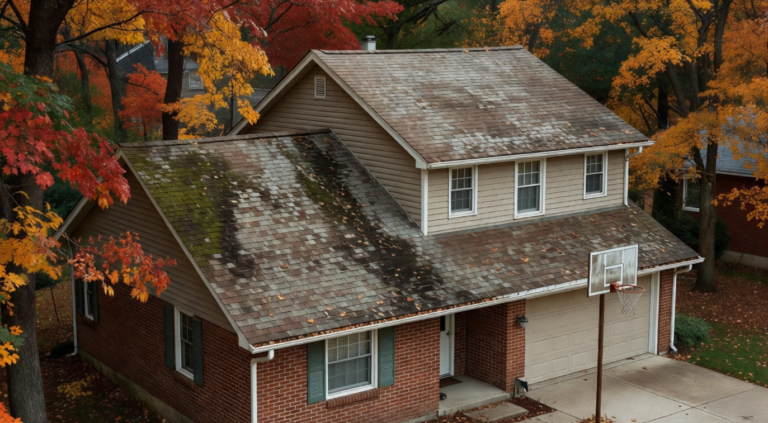
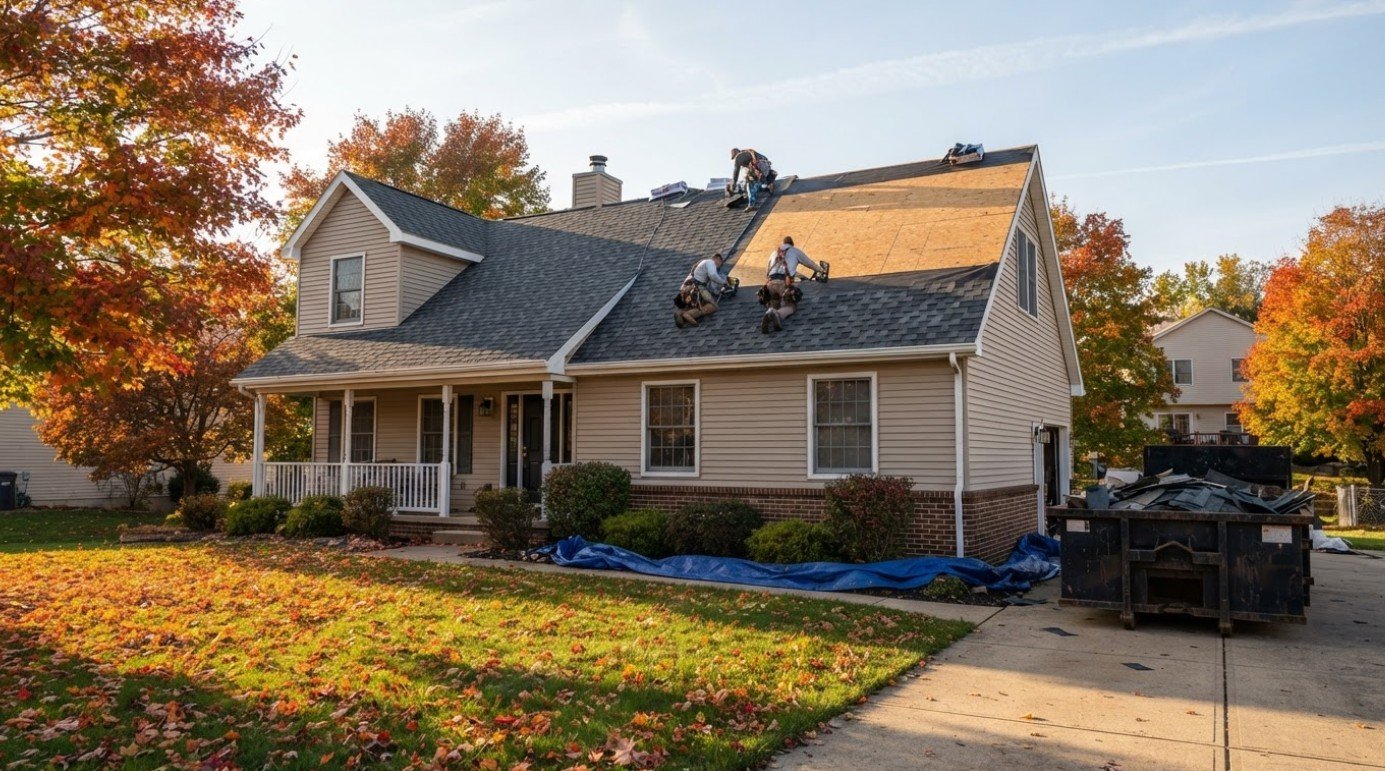
Pittsburgh’s normal first measurable snow lands on October 15, and the season’s 41.4 inches arrive faster than most homeowners expect: a quarter of it is down by New Year’s Eve and nearly four fifths by the end of February. That calendar, not the contractor’s schedule, is what decides when a Western Pennsylvania roof should be torn off.
Pittsburgh’s normal first measurable snow arrives around October 15, according to National Weather Service snowfall normals. That date sets the real calendar for a roof replacement in Western Pennsylvania. Late spring through early fall gives crews the easiest conditions, but a winter job can still be done right when a few precautions are followed.
Which months are best for a roof replacement near Lower Burrell?
May, June, September and early October are best, because asphalt shingles stay flexible and the sun warms the sealant strips that hold each shingle down. The same NWS normals show how fast the window closes. Pittsburgh’s seasonal snowfall averages 41.4 inches, with 10.8 inches on the books by the end of December and 32.5 inches by the end of February.
Spring has its own catch. Rain delays are common, and a roof deck (the plywood or boards under the shingles) should never sit open overnight in wet weather. A good crew checks the forecast and only tears off the section it can dry in that day. October is a fair backup month, since the normal snowfall for the whole month is only 0.4 inch, but daylight is shorter and mornings can be frosty.
Put the variables side by side and the window is narrower than the calendar suggests. September is the quiet month in Pittsburgh’s climate record: it averages only 9.8 days with measurable precipitation, the fewest of any month, with a normal high of 75 degrees and 12 hours 24 minutes of daylight. July and August are drier than spring but hot. May and June carry 13.5 and 12.4 wet days.
| Month | Normal high | Days with precipitation | Normal snowfall | Daylight at mid-month | Verdict |
|---|---|---|---|---|---|
| April | 62.4 F | 13.9 | 1.5 in | 13 h 14 m | Workable, rain-delay prone |
| May | 71.9 F | 13.5 | 0 | 14 h 24 m | Good |
| June | 79.4 F | 12.4 | 0 | 15 h 03 m | Good |
| July | 82.9 F | 11.2 | 0 | 14 h 47 m | Dry but hot |
| August | 81.7 F | 10.5 | 0 | 13 h 46 m | Dry but hot |
| September | 75.1 F | 9.8 | 0 | 12 h 24 m | Best of the year |
| October | 63.1 F | 11.1 | 0.4 in | 11 h 03 m | Fair backup, frosty mornings |
| November | 50.9 F | 12.0 | 2.1 in | 9 h 52 m | Cold-weather methods apply |
| December | 40.6 F | 14.6 | 8.3 in | 9 h 17 m | Dry days only |
| January | 36.3 F | 16.8 | 11.5 in | 9 h 35 m | Hardest month |
| February | 39.6 F | 13.9 | 10.2 in | 10 h 36 m | Hard, slightly drier |
| March | 49.1 F | 14.0 | 7.4 in | 11 h 52 m | Improving, still snowy |
The daylight column is the constraint nobody quotes in an estimate. A crew with a 14-hour envelope in June has fewer than 10 hours in November, and part of that is lost waiting for frost to burn off. The same two-day job becomes a three-day job, which means one more night with part of the roof dried in rather than finished.
How do you pick a contractor and a date?
Start with an inspection and a written estimate several weeks before you want the work done. Community Pro Roofing, based in Vandergrift, offers roofing services in pennsylvania that include free estimates, repairs and full replacements for homes in Lower Burrell, New Kensington, Leechburg and Murrysville. Its page lists Owens Corning asphalt shingles, which it calls the most common choice in Lower Burrell.
The same page says an inspection takes about an hour. It also says a typical replacement takes one to two days, depending on home size and weather. Those numbers help when you are planning around a dry forecast. A short job is easier to fit between storms than a long one. Ask the roofer which slopes get done first and how the crew protects the house if the weather turns mid-job.
Work backward from the date you want, not forward from today. If you want shingles down in the second week of September, the inspection belongs in late July and the signed contract in early August. Good crews in Westmoreland County book out, and the homeowner who calls in August for a September job is choosing from whatever is left rather than from the calendar.
Can a roof be replaced in winter?
Yes, on a dry day with the roof clear of ice and frost, but cold changes how the work is done. The Asphalt Roofing Manufacturers Association says shingles become less flexible as temperatures drop. Bending them cold can crack them, especially at hips, ridges and valleys.
The association lists several fixes for cold weather:
- Store shingle bundles indoors until the day of the job
- Wait until ice and frost are gone from the roof surface
- Hand-seal tabs with approved asphalt roofing cement, which means dabbing sealant under each tab so it grips even when the sun is weak
- Consider open metal valleys, because closed-cut and woven valleys require bending the shingle
Sealing time also depends on slope, direction and sun exposure. A north-facing slope in January may seal slowly on its own, which is why hand-sealing matters most in the cold months.
It is worth being precise about what the cold does and does not rule out. ARMA sets no temperature cutoff at all, and neither does GAF, which states in its technical bulletin on temperature extremes that there is no practical lower limit for applying asphalt fiberglass shingles as long as the right precautions are taken. What GAF does say is that shingles are easiest to handle above 40 degrees, and that storing bundles in a heated space above 70 degrees for at least 24 hours before installation makes them noticeably more pliable. Those two numbers are the honest version of “winter roofing”: not a prohibition, a handling problem with known fixes.
ARMA adds one precaution that rarely reaches a homeowner conversation: on a re-roof over an existing layer, the old surface has to be smooth, because any unevenness gets locked into the new shingles permanently.
| Cold-weather step | What it is actually solving | What happens without it |
|---|---|---|
| Indoor storage before the job | Shingles are brittle when cold and pliable above 70 F | Cracking at the fold line on caps and valleys |
| Waiting out frost and ice | Traction and a dry deck for underlayment adhesion | Fall risk, trapped moisture under the membrane |
| Hand-sealing tabs | Sealant strips need heat the winter sun cannot supply | Blow-off in the first strong wind before spring |
| Open metal valleys | Woven and closed-cut valleys require bending shingles | Cracks in the one place water concentrates |
| Pressing shingles flat before nailing | Cold shingles keep the curve of the bundle | Nails break through the surface instead of seating |
| Nailing in the common bond on laminates | Holds the shingle until the adhesive activates in spring | Uplift during the months before the seal sets |
The practical test for a winter date is not the thermometer. It is whether the crew will commit to indoor storage, hand-sealing every course, and open metal valleys, and whether they will put that in writing. A contractor who shrugs at those three is not equipped for a January roof, whatever the forecast says.
Does a replacement need a permit in Pennsylvania?
Often not, but the work must still meet code. A September 2025 re-roof letter from the PA Code Alliance says a residential re-roof generally does not require a building permit under the state Uniform Construction Code. The same letter says a permit would be required if the job involves structural work, such as replacing rafters, trusses or headers.
Without a permit there is also no municipal inspection. If a dispute comes up, the letter notes it must be settled between the owner and the contractor. Call your borough or city office before you sign, since local rules can differ. Keep your signed contract and the manufacturer warranty paperwork in one folder, because those documents are your record if a problem shows up later.
The letter is blunter than that summary suggests, and homeowners should read the consequence rather than the convenience. Its exact wording is that a residential re-roof “still requires compliance with the provisions of the UCC but does not require a building permit.” It then transfers a list of verification duties, including confirming the rafters are adequate for the new load, drainage, and the 90 mph wind design criterion, to the homeowner and contractor as their sole responsibility. The phrase that follows is the one worth remembering: “any and all problems that may arise between the owner and contractor must be settled between themselves.”
| Scope of work | Building permit | Who verifies code compliance |
|---|---|---|
| Tear off and reshingle | Generally not required | Homeowner and contractor |
| Metal over existing shingles | Generally not required, with limits | Homeowner and contractor |
| Replacing rafters, trusses or headers | Required | Municipal code official |
| Replacing studs or framing members | Required | Municipal code official |
| New or enlarged roof openings | Check locally | Varies by municipality |
No permit means no third party checks the work. That is a real argument for choosing the contractor more carefully than you would if an inspector were coming, and for keeping photographs of the deck after tear-off and before the underlayment goes on. Those photos are often the only record that exists of what was under the old roof.
The code detail that matters most on a Western Pennsylvania roof
If only one code requirement is worth knowing on a Lower Burrell re-roof, it is the ice barrier. Western Pennsylvania has the eave ice history that triggers it, and because no inspector is coming, it is the item most likely to be quietly skipped or under-run to save a roll of membrane.
Section R905.1.2 of the residential code, as adopted in Pennsylvania through the UCC, requires the barrier to run from the lowest edge of every roof surface to at least 24 inches inside the exterior wall line of the building. That measurement is the part homeowners and some crews get wrong. It is not 24 inches from the gutter and it is not one course of membrane. The overhang does not count toward the 24 inches, so on a house with a 16-inch overhang the barrier has to run roughly 40 inches up the slope before it has met the minimum. On roofs pitched 8:12 or steeper, it must also extend at least 36 inches along the slope from the eave edge.
Two things satisfy the requirement: two or more layers of underlayment cemented together, or a self-adhering polymer-modified bitumen sheet used in place of the normal underlayment. In practice everyone uses the membrane. It applies to asphalt shingles, metal roof shingles, mineral-surfaced roll roofing, slate, wood shingles and wood shakes.
What should you do before the crew arrives?
A few small tasks keep the job on schedule. Use this short list:
- Move cars out of the driveway so crews can park near the house
- Look in the attic for daylight, damp insulation or stains around nail tips, and show them to the roofer
- Trim branches that hang over the roof
- Choose shingle colors before the crew is booked
- Ask what will protect landscaping, siding and the driveway
Roofs over 20 years old deserve a professional look even if nothing is leaking. Granules in the gutters, curled edges and stains on ceilings are all signs that a replacement is coming. Booking the inspection in late summer gives you a full autumn window. If you miss it, a cold-weather plan is still a sound option.
Pick the season first, then the contractor, then the shingle color. That order keeps the decision simple and the roof dry.
Frequently Asked Questions
What is the best month to replace a roof near Lower Burrell?
September. Pittsburgh’s climate normals show it has the fewest days with measurable precipitation of any month at 9.8, a normal high of 75 degrees that keeps shingles flexible without cooking the crew, and still 12 hours 24 minutes of daylight. May and June are close behind and often easier to book.
Can a roof really be replaced in January in Western Pennsylvania?
Yes, on a dry day with the roof clear of ice and frost. Neither the Asphalt Roofing Manufacturers Association nor GAF sets a lower temperature limit for asphalt shingles. What changes is the method: bundles stored indoors, tabs hand-sealed with approved asphalt roofing cement, open metal valleys instead of woven or closed-cut, and shingles pressed flat before nailing.
Why does cold weather require hand-sealing?
Asphalt shingles seal themselves with a heat-activated adhesive strip that needs sun and warmth to bond. In winter the sun is too weak to activate it promptly, so the crew dabs approved asphalt roofing cement under each tab by hand. Without it the shingles can lift in the first strong wind before spring warms the roof.
Does a roof replacement need a permit in Pennsylvania?
Generally no. A September 2025 re-roof letter from the Pennsylvania Municipal Code Alliance states that a residential re-roof still requires compliance with the Uniform Construction Code but does not require a building permit. A permit is required if the work involves structural members such as rafters, trusses, headers or studs. Local rules can differ, so call your borough or city office first.
If no permit is needed, who checks the work?
You and your contractor. The letter transfers verification duties, including whether the rafters are adequate for the new load, drainage and the 90 mph wind design criterion, to the homeowner and contractor as their sole responsibility, and states that problems between owner and contractor must be settled between themselves. That is the strongest argument for vetting the contractor carefully and photographing the deck after tear-off.
How far does the ice barrier have to extend?
From the lowest edge of each roof surface to at least 24 inches inside the exterior wall line, per Section R905.1.2 as adopted in Pennsylvania. The overhang does not count, so on a house with a 16 inch overhang the membrane runs roughly 40 inches up the slope. On roofs at 8:12 or steeper it must also extend at least 36 inches along the slope from the eave.
What counts as an ice barrier?
Either two or more layers of underlayment cemented together, or a self-adhering polymer-modified bitumen sheet used in place of the normal underlayment. In practice nearly every crew uses the self-adhering membrane. The requirement covers asphalt shingles, metal roof shingles, mineral-surfaced roll roofing, slate, wood shingles and wood shakes.
How long does a roof replacement take?
One to two days for a typical home, depending on size and weather, according to Community Pro Roofing’s published figures. Count on longer in late autumn and winter, because the usable day shrinks from about 15 hours in June to under 10 hours in November and part of that is spent waiting for frost to clear.
Is spring a good time to replace a roof?
It is workable but rain-delay prone. April and May average 13.9 and 13.5 days with measurable precipitation. The real risk is an open roof deck sitting exposed overnight in wet weather, so ask the contractor to confirm the crew only tears off what it can dry in that day.
What about replacing a roof in October?
Early October is a fair backup. The whole month carries a normal snowfall of only 0.4 inch, and the normal high is 63 degrees. The constraints are daylight, down to 11 hours at mid-month, and frosty mornings that delay the start. The normal date of first measurable snow is October 15, so the second half of the month is a gamble.
How far ahead should I book the inspection?
Several weeks before you want the work, and ideally in late summer for an autumn job. An inspection takes about an hour. Working backward, shingles down in the second week of September means an inspection in late July and a signed contract in early August, because good crews in Westmoreland County fill their autumn schedule early.
What are the signs a roof needs replacing rather than repairing?
Granules collecting in the gutters, curled or lifted shingle edges, and stains on interior ceilings. Any roof past 20 years deserves a professional look even with no active leak. Checking the attic for daylight through the deck, damp insulation or dark rings around nail tips often finds the problem before it shows up inside.
Free Roofing Calculators
Sources
- National Weather Service, Pittsburgh snowfall normals (October 15 normal first measurable snow, 41.4 inch seasonal normal, 10.8 inches by December 31, 32.5 inches by February 28, 0.4 inch October normal)
- NOAA National Centers for Environmental Information, 1991-2020 monthly climate normals for Pittsburgh International Airport (normal daily maximum temperatures, normal days with precipitation of 0.01 inch or more)
- Asphalt Roofing Manufacturers Association, recommendations for installation of asphalt roofing shingles in cold weather (indoor storage, frost and ice, hand-sealing with approved asphalt roofing cement, open metal valleys, pressing shingles flat before nailing, re-roof surface smoothness)
- GAF Technical Bulletin R-133, temperature extremes and fiberglass asphalt shingles (no practical lower temperature limit, 40 degree handling guidance, storage above 70 degrees for 24 hours, common bond nailing on laminates)
- Pennsylvania Municipal Code Alliance re-roof letter, September 9, 2025 (no building permit required for a residential re-roof under the UCC, permit required for structural work, owner and contractor responsibility for compliance and disputes)
- Pennsylvania Municipal Code Alliance ice barrier support document, December 1, 2023 (IRC Section R905.1.2, 24 inches inside the exterior wall line, 36 inches along the slope at 8:12 and steeper, qualifying materials, accessory structure exception)
- Daylight durations computed from solar geometry for 40.44 degrees north latitude
Disclaimer: Climate normals describe long-term averages, not any particular year, and a mild December or a wet September will not match the table above. Permit and code requirements come from the edition of the Uniform Construction Code adopted in your municipality and from local amendments, so confirm both with your borough or city office before signing a contract. Service areas, inspection times and job durations attributed to a contractor come from that contractor’s own published material. This article is general information, not a code ruling or a construction specification.