Leaks on low-slope roofs start at details, not in the open field of the membrane: penetrations, wall and parapet flashings, seams, drains, and ponding areas. Water can travel 20 to 30 feet or more under the membrane before it surfaces inside, so the stain marks the exit, not the entry. Pittsburgh’s 35 freeze-thaw cycles a year pull at exactly those details every winter.
Ask a crew that repairs low-slope roofs where leaks start, and the answer isn’t “in the middle of the membrane.” It’s almost always at a detail: a spot where the roof has to meet something else. That’s good news, because details are repairable.
The challenge is finding the right one, since water on a flat roof can travel a long way before it shows up inside.
Why the Stain Lies
On a pitched roof, water mostly runs straight down. On a flat or low-slope roof, water that gets under the membrane can move sideways along the deck, through insulation, or along a seam, sometimes thirty feet or more, before it finds a gap in the ceiling below.
The ceiling stain marks where the water came out, not where it came in. Patching directly above a stain is one of the most common reasons repairs fail.
The Usual Suspects, Ranked by How Often They’re Guilty
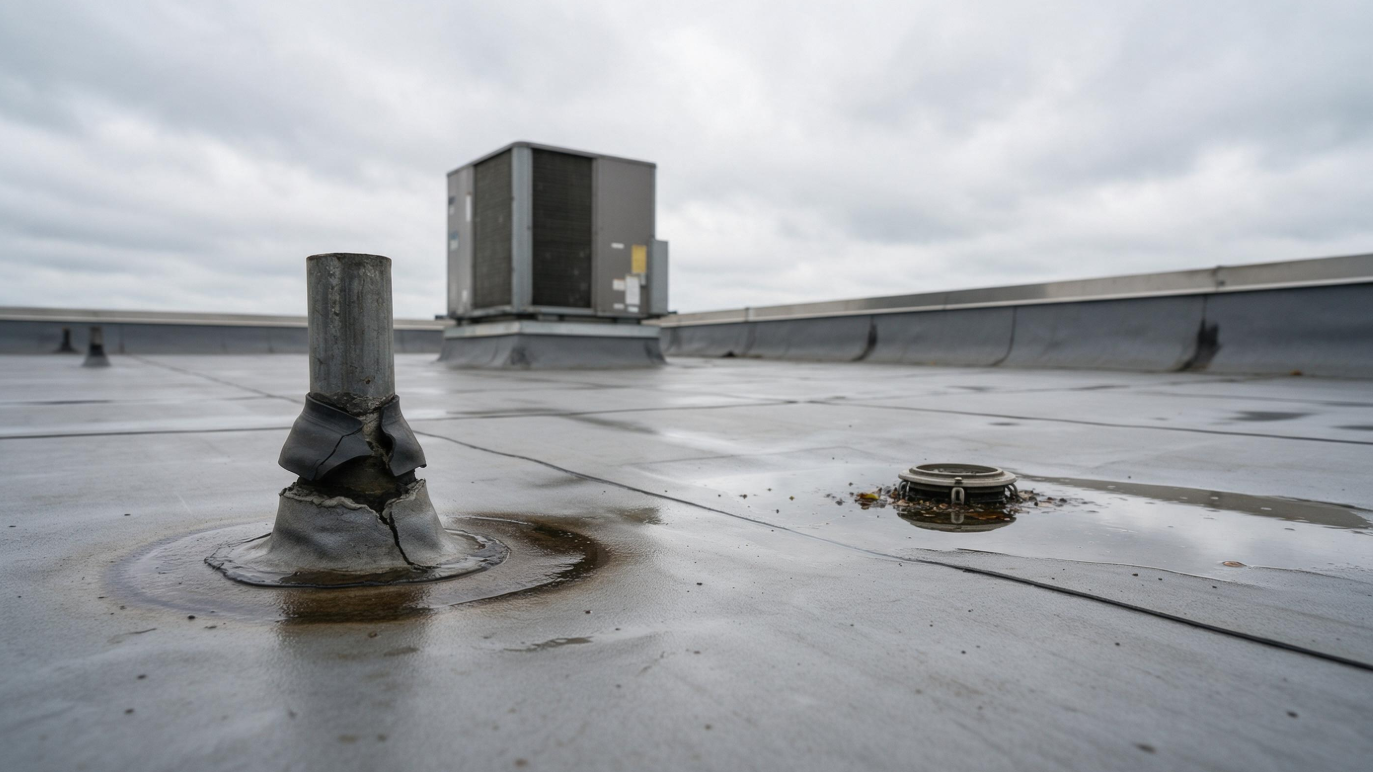
1. Penetrations. Pipes, vents, conduits, and curbs for rooftop units interrupt the membrane. The seal around each one depends on flashing, sealant, or a boot, and any of them can crack, shrink, or separate with age.
2. Wall and parapet flashings. Where the membrane runs up a wall, it’s held by terminations and sealant. Freeze-thaw movement pulls at these details every winter, a particular issue in a climate like Pittsburgh’s.
3. Seams. Welded seams on single-ply membranes can separate if the weld was weak or the roof has moved. Adhesive or taped seams on older rubber membranes can lose their bond over time.
4. Drains and scuppers. Clamping rings loosen and drain bowls clog. Debris blocks flow, water backs up, and the roof starts holding water around the very opening meant to remove it.
5. Ponding areas. Standing water that sits for more than about 48 hours accelerates wear and finds any weakness. Low spots can come from deck deflection, settled insulation, or poorly sloped original work.
6. Punctures and traffic wear. Technicians servicing HVAC units, dropped tools, and foot traffic along the same path wear membranes at predictable points.
7. Blisters and splits. In built-up and modified bitumen roofs, trapped moisture can form blisters. In some single-ply membranes, shrinkage can pull and tear at corners and flashings.
Why Pittsburgh stresses the top two: the region averages about 35 freeze-thaw cycles a year alongside roughly 42 inches of annual rainfall. Each cycle expands and contracts the terminations, sealants, and metal at every detail. Published guidance for this market specifically names flashings, drains, and perimeter transitions as the points where snow, ice, and freeze-thaw add the most stress.
Symptom to Likely Source
| What you see inside | Look first at |
|---|---|
| Stain near an exterior wall | Parapet or wall flashing |
| Stain below a rooftop unit | Curb flashing, condensate lines |
| Stain that appears after rain, then dries | Seam or penetration |
| Stain that lingers days after rain | Ponding, wet insulation, or a drain issue |
| Stain near an interior column or drain line | Drain bowl, clamping ring, or leaking pipe |
Treat this as a starting point for the search rather than a diagnosis. The pattern narrows where to look first, and the methods below confirm it.
The 48-Hour Rule, and Why Ponding Deserves Its Own Attention
The 48-hour threshold comes from NRCA guidance: water that remains on a low-slope roof 48 hours or more after rain ends, in normal drying weather, is ponding rather than ordinary standing water. Some water after a storm is expected. Water that will not drain is the problem.
Ponding matters for three reasons beyond membrane wear:
- Load. Ponded water adds roughly 5.2 pounds per square foot for every inch of depth. A few inches across a large area is substantial weight the structure may not be designed to carry indefinitely.
- The deflection spiral. Water collects in a sag, the added weight deepens the sag, and the deeper sag holds more water. Saturated or crushed insulation then creates new low spots.
- Warranty exposure. Most membrane warranties exclude damage tied to standing water that could have been corrected, which means a documented ponding area left alone can cost you coverage as well as membrane life.
Industry guidance generally recommends a positive slope of about one-quarter inch per foot for adequate drainage. Roofs flatter than that tend to pond repeatedly, which is why a ponding problem is sometimes a design issue rather than a maintenance one.
How Professionals Actually Find It
Guessing and patching is expensive. A systematic search narrows things down:
- Visual inspection of every detail, with photos, along with a review of any past repair history.
- Moisture surveys. Infrared imaging or other tools can show where insulation is holding water, which often traces back toward the entry point.
- Electronic leak detection. On some membranes, an electrical survey can pinpoint breaches.
- Controlled water testing. Sections of the roof are wetted one at a time to isolate the source.
- Core samples to confirm whether insulation is wet and how much of it needs to be replaced.
The order matters as much as the list. Visual inspection and repair history are cheap and often sufficient. Moisture mapping comes next because it defines the wet area, which is what determines scope. Water testing and core sampling confirm the finding before anyone writes a scope that involves opening the roof.
What Diagnosis and Repair Actually Cost
Diagnosis is a smaller line item than most owners expect, and it is the one that determines whether the repair money is well spent.
| Item | Typical cost |
|---|---|
| Infrared thermography survey | $400 – $1,200 |
| Electronic leak detection | $500 – $1,500 |
| Water flood testing | $200 – $500 per section |
| Minor repair, single leak point | $200 – $800 |
| Moderate repair, multiple areas or flashing work | $800 – $2,500 |
| Major repair or section replacement | $2,500 – $5,000+ |
| Emergency, after-hours or weekend | Add 25 – 50 percent |
Set that against the alternative. A repeated patch-and-hope cycle costs the same few hundred dollars several times over while the wet area spreads, and the interior damage, mold remediation, and eventual insulation replacement arrive anyway. A moisture survey that costs less than one moderate repair is what tells you which of those two paths you are on.
Repair, Re-Seal, or Rethink
A narrow failure, like a cracked pipe boot or a lifted seam, calls for a targeted repair. Wet insulation, however, needs to be removed and replaced, since a patch on top won’t dry it out. If moisture surveys show widespread saturation, repeated leaks, or a membrane near the end of its life, it’s worth discussing coating or replacement alongside the repair.
Membrane age is part of that judgment. Typical service lives for common low-slope systems run roughly as follows, before climate and maintenance are factored in.
| System | Typical service life | Where it tends to fail |
|---|---|---|
| TPO, 60 mil | 20 – 30 years | Welded seams, corners, flashing terminations |
| EPDM, 60 mil | 20 – 30 years | Adhesive or taped seams, shrinkage at details |
| PVC, 60 mil | 25 – 35 years | Welded seams, penetrations |
| Modified bitumen | 15 – 25 years | Blisters from trapped moisture, laps, flashings |
A roof at year eight with one failed boot is a repair. The same roof at year twenty-four with three leaks and documented saturation across several bays is a replacement conversation, and the moisture survey is what separates the two cases.
Keep a Roof File
A simple record pays for itself:
- Dates and locations of every leak
- Photos before and after each repair
- Moisture survey results
- Warranty documents and who to call
- Inspection reports twice a year, spring and fall
Two reasons this is worth the effort. A pattern of leaks across the same area is evidence for a scope decision that a series of disconnected service calls will never produce. And because warranties commonly exclude damage from uncorrected standing water, dated records showing you identified and addressed a ponding area protect your coverage.
Choosing Who Repairs It
Look for a contractor that diagnoses before it patches, documents what it finds, and knows the specific membrane on your roof, whether TPO, EPDM, PVC, or modified bitumen.
A provider of commercial roof repair in Pittsburgh should be able to explain where the water is entering, show you proof, and give you a written scope for the fix. If someone offers a repair without finding the source first, that’s a patch, not a solution.
A few questions separate diagnosis from guesswork:
- What method will you use to locate the entry point, and what does that cost?
- Will I receive photos and a moisture map showing the wet area?
- How much insulation needs to come out, and how did you determine that?
- Is my membrane type one your crews weld or seam regularly?
- Will this repair affect my existing warranty, and have you confirmed that with the manufacturer?
- What is the written scope, and what is excluded from it?
Frequently Asked Questions
Why is the ceiling stain not under the leak?
On a low-slope roof, water that gets past the membrane travels sideways along the deck, through the insulation, or along a seam before it finds a gap in the ceiling. That distance is commonly 20 to 30 feet and can be more. The stain marks where the water exited, not where it entered.
Where do commercial flat roofs leak most often?
At details rather than in the open field of the membrane. In rough order of frequency: penetrations such as pipes, vents, and rooftop unit curbs; wall and parapet flashings; seams; drains and scuppers; ponding areas; punctures and traffic wear; and blisters or splits.
Why does patching above a stain usually fail?
Because it seals the exit point while the entry point stays open. The next rain follows the same path and the stain returns, often slightly offset, which is why repeated patching in the same area is a sign the source was never located.
What counts as ponding on a flat roof?
Water that remains 48 hours or more after rain ends in normal drying weather, per NRCA guidance. Some standing water right after a storm is expected. Water that will not drain within that window is ponding and needs attention.
Why is ponding water a structural concern?
Ponded water adds about 5.2 pounds per square foot for each inch of depth, so a few inches across a large area is significant load. It also creates a deflection spiral, where water collects in a sag, the weight deepens the sag, and the deeper sag holds more water.
Can ponding void my roof warranty?
It can. Most membrane warranties exclude damage tied to standing water that could have been corrected. Dated records showing you identified and addressed a ponding area help protect coverage, which is one reason a roof file is worth keeping.
How do professionals locate a flat roof leak?
A sequence: visual inspection of every detail with photos plus a review of repair history, then a moisture survey using infrared or similar tools to map where insulation is holding water, then electronic leak detection or controlled water testing to pinpoint the breach, and core samples to confirm how much wet insulation must be replaced.
How much does commercial roof leak detection cost?
Infrared thermography commonly runs $400 to $1,200, electronic leak detection $500 to $1,500, and water flood testing $200 to $500 per section. That is usually less than a single moderate repair, which is why diagnosis before patching tends to pay for itself.
How much does a commercial roof leak repair cost?
Roughly $200 to $800 for a minor single leak point, $800 to $2,500 for moderate work involving multiple areas or flashing, and $2,500 to $5,000 or more for major repairs or section replacement. Emergency after-hours or weekend work typically adds 25 to 50 percent.
Can wet insulation dry out on its own?
No. Wet insulation needs to be removed and replaced, because a patch over the top does not dry what is underneath. This is why core samples and a moisture map matter: they determine how much material actually has to come out.
When does a flat roof need replacement rather than repair?
When moisture surveys show widespread saturation, leaks keep recurring across different areas, or the membrane is near the end of its service life. TPO and EPDM typically run 20 to 30 years, PVC 25 to 35, and modified bitumen 15 to 25. A young roof with one failed detail is a repair; an aging roof with documented saturation across several bays is a replacement conversation.
Why are Pittsburgh flat roofs harder on flashings?
The region averages about 35 freeze-thaw cycles a year alongside roughly 42 inches of annual rainfall. Each cycle expands and contracts the terminations, sealants, and metal at every detail, which is why flashings, drains, and perimeter transitions are named as the highest-stress points in this market.
Free Roofing Calculators
Sources
- R and E Roofing, Commercial Roof Leak Repair guide (leak detection and repair cost ranges, water travel distance, emergency premium)
- Smart Roofing Pros, flat roof ponding guide citing NRCA’s 48-hour definition and ARMA slope guidance (ponded water load per inch, deflection spiral, warranty exclusions)
- Commercial Roof Guide, Pittsburgh PA commercial roofing data (35 freeze-thaw cycles per year, 42 inches annual rainfall, membrane service lives, regional failure points)
Disclaimer: Costs, service-life ranges, and climate figures in this guide are 2026 estimates compiled from published contractor and industry sources for planning purposes only. Actual pricing depends on roof size, membrane type, access, and the extent of saturation found. Ponding and structural load questions should be reviewed by a licensed engineer. Confirm warranty implications with your membrane manufacturer before any repair.