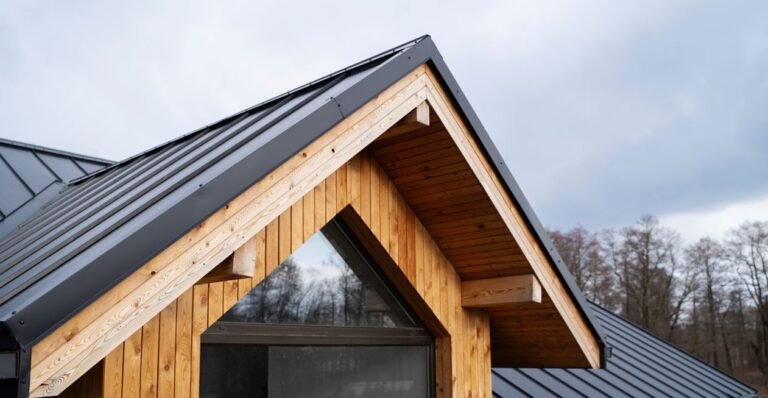
Metal Roof Snow Guards vs Snow Rails:
Snow guards are individual pads or cleats spread across the roof in staggered rows. Snow rails are continuous bars clamped along the slope. Guards cost less and hide better but are only rated to roughly 45 psf ground snow load. Above that, rails are the engineered choice.
A metal roof panel is smooth, non-porous and rigid, so snow does not shed a little at a time the way it does on asphalt shingles. It bonds, then releases as a single slab. That slab can tear off gutters, crush a car or land on someone walking below.
Snow retention is how you stop that. The real question is not whether you need it. It is which of the two families of hardware matches your snow load, your panel type and your slope length. This guide answers that with numbers, not opinions.
Planning a new metal roof or budgeting a replacement before you spec snow retention?
Run the Roof Replacement Cost CalculatorTable of Contents
Snow Guards vs Snow Rails: Quick Comparison
Both systems solve the same problem. They differ in how they collect load and where that load ends up.
| Factor | Snow Guards (pads / cleats) | Snow Rails (bars / fences) |
|---|---|---|
| Form | Individual units in staggered rows | Continuous horizontal bar or pipe on clamps |
| Load path | Point loads into each panel flat or seam | Line load shared across every clamped seam |
| Practical snow load ceiling | Up to about 45 psf ground snow load | No practical ceiling when engineered |
| Installed cost per linear foot | Roughly $8 to $16 | Roughly $12 to $40 |
| Visibility from the street | Low, especially clear polycarbonate | Higher, though color-matched options exist |
| Rows typically needed | Multiple staggered rows up the slope | Often one or two rows near the eave |
| Install season | Adhesive types need above 40 F and a cure window | Clamp-on types install in any temperature |
| Best fit | Moderate snow, shorter slopes, budget jobs | Heavy snow, long rafters, entries and walkways |
What Snow Guards Are and How They Work
Snow guards do not hold a snowpack in place as one mass. They break it up. Each unit interrupts the slab so it releases in smaller pieces instead of one sheet, which is why they are installed across the whole roof plane rather than in one line.
Pad-style adhesive guards
Clear polycarbonate pads bonded to the panel flat with a structural adhesive. They are the least visible option and add no penetrations. SnoBlox-Snojax notes that these bonds need roughly 50 F and about 28 days to reach full cure, and the manufacturer-recommended adhesive must cover the entire base to seal the interface. Install them in October and you may not have a working system by December.
Pad-style screw-down guards
Stainless steel or aluminum pads mechanically fastened through the panel into decking or purlins. These are for exposed-fastener roofs only. Typical layouts call for staggered rows spaced 9 to 12 inches horizontally and 5 to 25 feet vertically depending on pitch, with the first row about 1 foot up from the eave.
Individual clamp-on cleats
Small metal cleats that grip a standing seam with set screws instead of penetrating it. They sit between pads and rails in both cost and strength, and they can be installed year round because there is no adhesive cure.
The isolation mistake. Placing a handful of guards only above a doorway or an HVAC unit is a documented high-failure pattern. Manufacturers are explicit that isolated rows concentrate the full sliding force into a few attachment points. Snow retention has to cover the entire roof plane.
What Snow Rails Are and How They Work
Snow rails do the opposite. They retain the snowpack as a mass and let it melt and drain rather than slide. Because the bar is continuous, load collected anywhere along it is shared by every clamp on that run.
Single-pipe and single-bar systems
One rail on clamps, usually set above the load-bearing wall rather than out over the gutter. This is the most common residential rail configuration and the entry point for engineered retention.
Dual-pipe and fence systems
Two or three tubes stacked in a taller clamp, or a vertical fence panel. These are for deep snow packs, long rafter runs and commercial entries. S-5! markets its two-pipe systems as spanning up to 48-inch seam spacing while still exceeding the holding strength of individual cleats.
Why the continuous bar matters structurally
Both technologies ultimately transfer force into the roof panel or its seams. The difference is distribution. With guards, whatever the tributary area behind one pad collects goes into that one attachment. With a rail, the same force is redistributed along the bar into many clamps at once, which is why rail systems carry higher published allowable loads pound for pound.
The 45 PSF Threshold That Decides Most Projects
There is one number that resolves this comparison faster than any aesthetic debate. Manufacturer guidance from SnoBlox-Snojax states that individual pad-style and clamp-on guards are not recommended where the ground snow load reaches 45 psf or higher. Above that, a bar or rail system is required.
This is a published product limit, not a code rule. But it appears consistently across spacing charts, which are all captioned “up to 45 PSF ground snow load.”
How to use the threshold
- Under 30 psf: Guards are usually adequate. Rails are a preference, not a requirement.
- 30 to 45 psf: Judgment zone. Slope length, pitch and what sits below the eave decide it.
- 45 psf and above: Specify rails. Pad guards are outside their published rating.
Get your site value from the ASCE 7 Hazard Tool rather than a state average. Ground snow load can vary by a factor of five inside one state.
How the Load Math Actually Works
Snow retention is sized against a sliding force, not the vertical snow weight. The industry method, described by Rocky Mountain Snow Guards, works in three steps.
- Vector force (psf) equals the roof snow load multiplied by the sine of the roof angle.
- Tributary force equals vector force multiplied by rafter length (eave to ridge) and panel width.
- Compare against the product’s allowable load, which is the tested ultimate load divided by a factor of safety.
On that last point, the Metal Construction Association recommends a factor of safety no less than 2.0 for mechanically attached snow guards, and S-5! applies the same 2.0 factor to its drag-test results. There is no ASTM standard governing snow guard testing, so published test data and its safety factor are the only real evidence you have.
The practical takeaway: force scales with rafter length. Two houses in the same town with the same snow load can need different systems purely because one has a 16-foot rafter and the other has a 34-foot rafter. Check your slope with the roof pitch calculator before assuming a layout.
2026 Cost Comparison
Angi’s March 2026 cost data puts a full professional snow guard installation at an average of $1,500, with most projects landing between $1,000 and $4,000. Small partial jobs start near $500, and large or complex roofs can exceed $10,000.
| System | Material $/linear ft | Installed $/linear ft | 100 ft of eave, installed |
|---|---|---|---|
| Adhesive polycarbonate pads | $3 to $7 | $8 to $14 | $800 to $1,400 |
| Screw-down metal pads | $4 to $8 | $9 to $15 | $900 to $1,500 |
| Individual clamp-on cleats | $5 to $9 | $10 to $16 | $1,000 to $1,600 |
| Single-pipe rail (ColorGard class) | $6.75 to $11.50 | $12 to $20 | $1,200 to $2,000 |
| Dual-pipe rail (DualGard / X-Gard class) | $11 to $17 | $20 to $30 | $2,000 to $3,000 |
| Fence-style rail | $15 to $25 | $25 to $40 | $2,500 to $4,000 |
Other line items worth budgeting: permits run $50 to $200 where required, minimum service fees are $200 to $400, and sales tax on materials and labor can add 5 to 10 percent. Replacing an individual damaged guard later costs $10 to $40 per piece plus labor.
Roof Panel Compatibility Decides What You Can Even Use
This constraint eliminates options before cost does. Standing seam panels float on hidden clips and move with thermal expansion. Penetrating them deforms the holes over time, causes leaks and voids the panel warranty.
| Attachment method | Standing seam | Exposed fastener (R-panel, PBR) |
|---|---|---|
| Adhesive polycarbonate pads | Yes | Yes |
| Screw-down metal pads | No, never | Yes, into purlins or decking |
| Seam-clamped cleats | Yes | Not applicable |
| Seam-clamped rails | Yes | Not applicable |
| Screw-down rails | No | Yes |
One more note in favor of clamped rails: because clamps use set screws rather than penetrations, they preserve the roof warranty and can be installed in any season, which adhesive pads cannot.

Snow Guards vs Snow Rails by US State
The table below pairs representative ASCE 7-22 ground snow loads with the system family those loads point to. Treat it as a planning starting point, then confirm your site value with the ASCE Hazard Tool or your building department.
| State | Representative pg (psf) | vs 45 psf line | Typical system |
|---|---|---|---|
| Maine | Augusta 70, Bangor 80 | Far above | Rails, often dual-pipe |
| New Hampshire | Concord 70, Manchester 60 | Far above | Rails |
| Vermont | Montpelier 60, Burlington 50 | Above | Rails |
| Minnesota | 50 statewide, 60 in 29 north counties | Above | Rails |
| Alaska | Anchorage 50, Juneau 60 | Above | Rails |
| Maryland | Baltimore 60, Annapolis 30 | Split | Rails in Baltimore, guards elsewhere |
| Washington DC | 62 | Above | Rails |
| Massachusetts | Boston 40, Worcester 50 | Borderline | Guards to rails by jurisdiction |
| Michigan | Lansing 30, Marquette 80 | Split | Guards south, rails in the UP |
| Colorado | Denver 43 ASD, mountains 100+ | Split | Guards Front Range, rails in mountains |
| Utah | Salt Lake City 30, Park City 75+ | Split | Guards valley, rails at elevation |
| Wyoming | Cheyenne 30, Jackson 80+ | Split | Guards east, rails in Teton County |
| New York | NYC 25, Albany 40, Buffalo case study | Split | Guards downstate, rails in lake-effect belt |
| Idaho | Boise 25, Sun Valley case study | Split | Guards in the valleys, rails at altitude |
| Montana | Helena 30 minimum roof load | Below to split | Guards, rails at elevation |
| North Dakota | Bismarck 40, Fargo 45 | At the line | Rails recommended |
| South Dakota | Pierre 35, Sioux Falls 35 | Below | Guards, rails on long slopes |
| Wisconsin | Madison 30, Milwaukee 30 | Below | Guards |
| Iowa | Des Moines 30 | Below | Guards |
| Washington | Seattle 20, Spokane 40, Cascades case study | Split | Guards west, rails in the Cascades |
| Oregon | Portland 25, Bend 40 | Below | Guards |
| Pennsylvania | Pittsburgh 25, Harrisburg 25 to 30 | Below | Guards |
| Ohio | Columbus 20, Cleveland 25 | Below | Guards |
| Illinois | Chicago 25, Springfield 20 | Below | Guards |
| Virginia | Richmond 25, Roanoke 20 | Below | Guards, rails over entries |
| North Carolina | Raleigh 15, Asheville 20 to 30 | Below | Guards, often over doorways only |
| Texas | Austin 0, Amarillo 10 | Well below | Rarely needed outside the Panhandle |
Regional Deep Dive
Northern New England and Minnesota
These are the clearest rail markets in the country. Augusta at 70 psf, Concord at 70 psf and Minnesota’s state-mandated 50 to 60 psf all sit well past the pad-guard ceiling. Minnesota is unusual in that Rule 1303.1700 fixes the number statewide rather than mapping it, which removes the ambiguity entirely.
The Mid-Atlantic surprise
ASCE 7-22 changed the answer here. Baltimore’s ground snow load moved from 25 psf under ASCE 7-16 to 60 psf under the reliability-targeted 7-22 values, and Washington DC moved from 25 psf to 62 psf. Homes that were correctly specified with pad guards a decade ago now sit in rail territory on paper. If you are re-roofing in Maryland or DC, do not reuse the old spec.
Mountain West
Colorado, Utah, Idaho and Wyoming are dominated by case study zones where ASCE 7-22 declines to map a value at all. Denver uses a 43 psf allowable-stress pg, but Aspen, Park City and Jackson require site-specific engineering that routinely lands above 100 psf. In those towns, dual-pipe rails with a stamped calculation are the norm, not an upgrade.
Great Lakes and lake-effect belts
State averages fail badly here. Cleveland sits at 25 psf while Marquette is at 80 psf, and Buffalo and the Tug Hill Plateau are case study areas that can exceed 100 psf. Within Michigan and New York, the same builder may spec pads on one job and fence rails on the next.
The South and low-load states
Across Texas, Florida, Georgia and the Gulf, ground snow load is effectively zero and retention is not a structural question. Where it is installed at all, it is usually a single row of pads over a front entry after one memorable ice event. Metal roofs in these states are budgeted around wind, not snow, and if you are pricing that work the metal roof cost calculator is the more useful tool.
Installation Details and How Each System Fails
Row count and spacing
A single row at the eave rarely stops a full sheet on a long slope. Published spacing charts cap vertical spacing at 15 to 25 feet depending on pitch, and steeper roofs need rows closer together because the snow accelerates faster. Guards go in a staggered pattern across every panel flat, not in a straight line.
Placement relative to the wall
Rails belong over the load-bearing wall, not cantilevered out above the gutter. Retained snow is a real load, and putting it past the wall line puts it on the weakest part of the assembly.
Common failure modes
- Skipped seams. Clamping every other seam on a rail run cuts holding strength roughly in half.
- Wrong set screw torque. Too loose and the clamp slides; too tight and the seam deforms.
- Adhesive applied cold. Below roughly 40 to 50 F the bond never fully cures.
- Isolated placement. Guards only above a door concentrate the whole roof’s sliding force into a few units.
- Screws into standing seam. Guaranteed to cause elongation, leaks and a voided warranty.
Durability and appearance
Both families last 20 years or more when correctly specified. The difference shows up in finish. Clear polycarbonate pads can yellow with UV exposure over time, which is the argument color-matched rail systems like ColorGard 2.0 make when they offer a warranty tied to the life of the roof. Rails are more visible from the street; pads are close to invisible until they discolor.
How to Choose: A Five-Step Framework
- Pull your ground snow load from the ASCE Hazard Tool for your exact coordinates, then confirm with the building department.
- Check the 45 psf line. At or above it, rails. Below it, guards are in play.
- Measure rafter length and pitch. Long or steep slopes push borderline projects toward rails. Get your roof area right first with the roof square footage calculator.
- Confirm panel compatibility. Standing seam eliminates every screw-down option immediately.
- Demand a layout with calculations. Ask for the tested allowable load and the factor of safety used. Anything less is a guess.
Frequently Asked Questions
Are snow rails always better than snow guards?
No. Rails hold more snow per linear foot, but on a 25 psf roof with a 16-foot rafter, staggered pad guards are within their rating and cost roughly half as much. Rails become necessary above about 45 psf, on long or steep slopes, and anywhere a slide would land on people or property.
Can I install snow guards only above my front door?
Manufacturers advise against it. Isolated placement concentrates the sliding force from the entire roof plane into a small cluster of attachments, and that pattern has a high documented failure rate. Snow retention should span the full roof plane.
Will snow guards or rails damage my metal roof?
Not when the attachment matches the panel. Clamp-on systems grip the seam with set screws and add no penetrations. The damage comes from screwing anything into a standing seam panel, which restricts thermal movement, elongates the holes and voids the panel warranty.
Do snow guards cause ice dams?
They do not create ice dams on their own. Ice dams come from heat loss melting snow that refreezes at a cold eave. Retention keeps snow on the roof longer, so if your attic insulation and ventilation are already poor, the symptom becomes more visible. Fix the thermal envelope first.
What time of year should snow retention be installed?
Clamp-on guards and rails can go on any time the roof is clear and dry. Adhesive-mounted polycarbonate pads need application temperatures above roughly 40 to 50 F and a cure window that can run 7 to 28 days, so late fall installs risk having no effective system for the first storm.
How many rows do I need?
It depends on pitch and slope length. Published pad-guard charts cap vertical spacing between rows at 15 to 25 feet, tightening as pitch increases. Rail systems often need only one or two rows because each run redistributes load across every clamp.
Does snow retention add load to my roof structure?
Yes, indirectly. Holding snow on the roof means the structure carries it rather than shedding it. ASCE 7, referenced by the IBC, governs how that load is calculated, and retained snow should be accounted for in the design rather than assumed away.
Do snow guards work on exposed fastener metal roofs?
Yes. Screw-down pads and screw-down rails are both designed for R-panel and PBR profiles and fasten into purlins or solid decking. Adhesive pads also work. What does not apply is seam clamping, since there is no standing seam to grip.
Is there a testing standard for snow guards?
No ASTM standard governs the use or testing of snow guards. Reputable manufacturers run load-to-failure drag tests on actual panel profiles, and the Metal Construction Association recommends a factor of safety of no less than 2.0 for mechanically attached systems. Ask for that test data by panel profile.
Will snow retention lower my insurance premium?
It will not raise it, and some insurers offer discounts for snow retention because it reduces the risk of gutter, vehicle and liability claims. Check directly with your carrier, since this varies by company and state.
Free Roofing Calculators
Roof Pitch Calculator
Find your exact pitch and roof angle, the input that drives every sliding force calculation.
Roof Square Footage Calculator
Convert footprint to actual roof area before you price panels or retention hardware.
Metal Roof Cost Calculator
Estimate installed metal roofing cost by material, panel type and roof size.
Sources
- ASCE 7-22, Minimum Design Loads and Associated Criteria for Buildings and Other Structures, Chapter 7, and the ASCE 7 Hazard Tool geodatabase.
- Maguire et al., Ground Snow Loads for ASCE 7-22, Structure Magazine, February 2022.
- SnoBlox-Snojax published spacing guidelines and standing seam compatibility guidance.
- Rocky Mountain Snow Guards, The Science Behind Snow Retention, including MCA factor of safety guidance.
- Sheffield Metals, The Technical Side of Snow Guards for Metal Roofing Systems.
- Angi, How Much Does It Cost to Install Snow Guards, 2026 cost data, updated March 2026.
- Minnesota Rule 1303.1700 and state building code amendments for state-mandated snow loads.
This guide is for planning and budgeting only. Ground snow loads vary sharply within a single county, and case study regions require a licensed engineer to perform a site-specific analysis. Confirm your design value with your local building department and have any snow retention layout backed by manufacturer calculations before installation.