Standing Seam vs Corrugated Metal Roof:
Standing seam hides its fasteners under raised interlocking seams and runs about $10 to $16 per square foot installed, lasting 40 to 70 years. Corrugated metal screws through the panel face, costs roughly $7 to $12 per square foot, and lasts 25 to 40 years. Standing seam wins on leaks, wind and resale. Corrugated wins on upfront price.
Both systems are steel or aluminum, both are non-combustible, and both outlive asphalt shingles. The difference is the fastener. One design keeps every screw out of the weather. The other puts thousands of rubber-washered screws directly in the sun and rain, and those washers are the part that fails first.
This guide compares the two on 2026 installed pricing, service life, minimum roof pitch, wind and hail ratings, solar compatibility, and how the decision changes across US states. Every figure below is tied to a named source or a stated assumption.
Want a dollar figure for your own roof before you read on?
Run the Roof Replacement Cost CalculatorQuick Comparison Table
Here is the head-to-head on the specifications that actually change the outcome of the project.
| Attribute | Standing Seam | Corrugated / Exposed Fastener |
|---|---|---|
| Fastener system | Concealed clips under the seam | Screws through the panel face |
| Installed cost (2026) | $10 to $16 per sq ft | $7 to $12 per sq ft |
| Service life | 40 to 70 years | 25 to 40 years |
| Typical gauge | 24 ga standard, 26 ga budget | 26 to 29 ga |
| Panel coverage width | 16 to 18 inches | 26 to 36 inches |
| Minimum slope (IRC) | 0.25:12 | 3:12, or 0.5:12 with lap sealant |
| Exposed penetrations | None in the panel field | Thousands per roof |
| Scheduled maintenance | Inspection and sealant only | Fastener replacement cycles |
| Solar mounting | Non-penetrating clamps | Penetrating brackets required |
| Best fit | Primary residence, long hold, coastal, low slope | Barns, shops, cabins, short hold, tight budget |
How the Two Systems Are Built
Standing seam: a concealed-fastener system
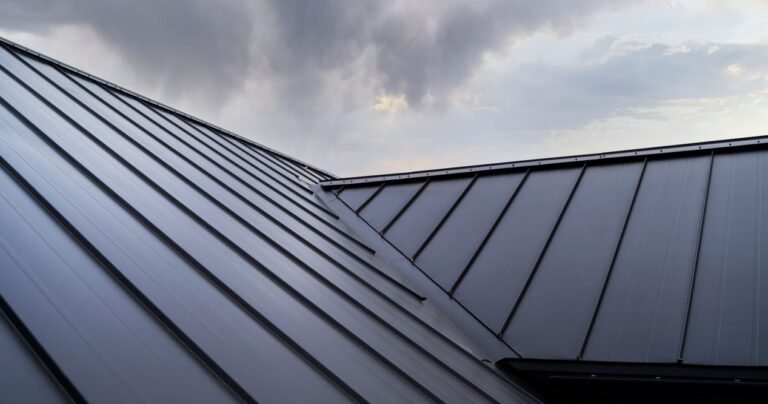
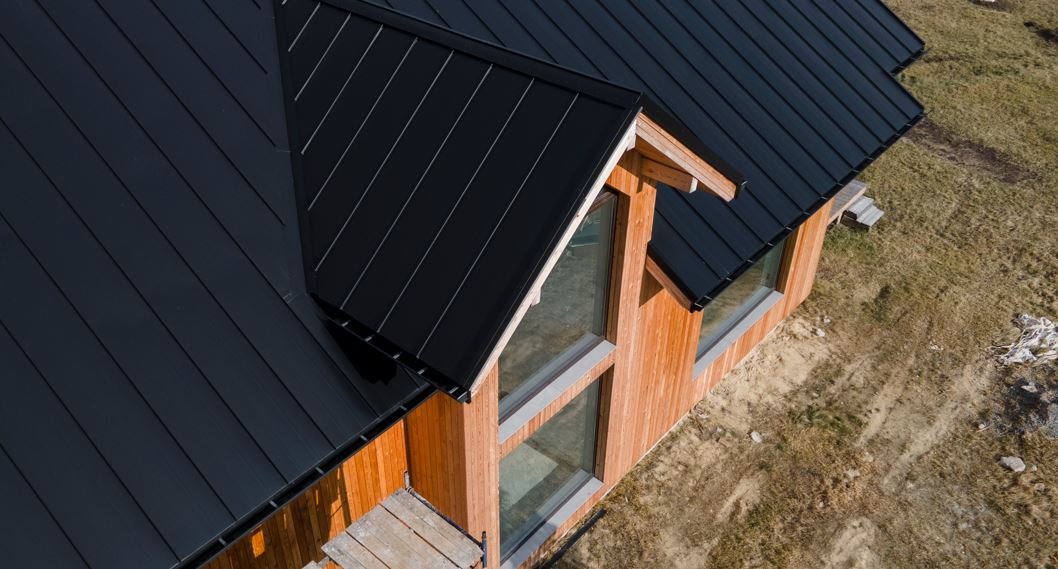
Standing seam panels run vertically from ridge to eave and lock together at raised seams that sit above the drainage plane. Clips underneath hold the panel to the deck, so no screw ever touches the weather surface in the field of the roof.
Two seam types dominate. Snap-lock panels press together by hand and cost less to install. Mechanically seamed panels are folded shut with a powered seamer, which is slower but produces the tightest assembly and the lowest slope tolerance.
Seam heights typically run 1 to 2 inches, and taller seams add rigidity and perform better under standing water. Effective coverage width is normally 16 to 18 inches, because wider panels show more waviness.
Corrugated: an exposed-fastener system
Corrugated and ribbed panels (7/8 inch corrugated, R-panel, PBR, 5V crimp) are screwed straight through the panel into the deck or purlin. A neoprene or EPDM washer under each screw head does the sealing. Panels are wider, so the roof goes on faster with less trim.
Exposed-fastener panels typically run 26 to 29 gauge, versus 24 gauge as the residential standing seam default. Thinner steel costs less and dents more.
The core engineering difference: standing seam moves the waterproofing away from every fastener. Corrugated asks a rubber washer to stay flexible and compressed for decades while sitting in direct UV and thermal cycling.
2026 Installed Cost Compared
Published 2026 ranges cluster tightly once you compare installed cost rather than panel-only cost. Below are the ranges reported by four independent sources.
| Source (2026) | Standing seam, installed | Corrugated, installed |
|---|---|---|
| Western States Metal Roofing | $10 to $16 / sq ft | $7 to $12 / sq ft |
| RoofVista | $10 to $16 / sq ft | $7 to $10 / sq ft |
| SquareDash | $8 to $12 / sq ft | Lowest metal tier |
| FoxHaven Roofing | $8 to $14 / sq ft | $4 to $8 / sq ft |
| Working range for this guide | $10 to $16 / sq ft | $7 to $12 / sq ft |
What actually moves the price
- Gauge. 24 gauge material costs roughly 30 percent more than 26 gauge, per Western States Metal Roofing and Sheffield Metals.
- Paint system. PVDF panels (Kynar 500, Hylar 5000) usually cost 30 to 40 percent more than SMP, and carry longer fade and chalk warranties.
- Seam type. Mechanically seamed costs more to install than snap-lock because of the powered seaming pass.
- Trim volume. A standing seam roof needs more trim than a corrugated roof, which widens the gap beyond the panel price alone.
- Substrate. Aluminum runs roughly 15 to 20 percent above equivalent steel pricing.
Cost by Roof Size
These figures use actual roof surface area, not house footprint. A 2,000 sq ft footprint on a 6:12 pitch covers about 2,236 sq ft of roof before waste. Measure yours with the roof square footage calculator before pricing anything.
| Roof area | Corrugated ($7 to $12) | Standing seam ($10 to $16) | Premium for standing seam |
|---|---|---|---|
| 1,500 sq ft | $10,500 to $18,000 | $15,000 to $24,000 | $4,500 to $6,000 |
| 2,000 sq ft | $14,000 to $24,000 | $20,000 to $32,000 | $6,000 to $8,000 |
| 2,500 sq ft | $17,500 to $30,000 | $25,000 to $40,000 | $7,500 to $10,000 |
| 3,000 sq ft | $21,000 to $36,000 | $30,000 to $48,000 | $9,000 to $12,000 |
Angi reports a 2,000 sq ft standing seam roof averaging $18,000 to $32,000 in 2026, which lands inside this table. For a material-by-material breakdown, run the metal roof cost calculator.
Lifespan and Maintenance
Panels are not the limiting factor on an exposed-fastener roof. The screws are. Industry maintenance guidance is consistent: panels can run 40 to 70 years while fasteners begin failing after 10 to 15 years, particularly under heat and moisture cycling.
The failure sequence is predictable. The washer compresses, flattens and cracks under UV. Water creeps down the screw shank. The screw rusts, then the panel rusts around it. Contractors handling this at the 10 to 15 year mark typically replace with oversized screws and wider washers to reseal holes that have widened from thermal movement.
| Maintenance item | Standing seam | Corrugated |
|---|---|---|
| Fastener inspection | Trim screws only | Full field, annually in humid or coastal areas |
| Washer replacement | Not applicable | Expected at 10 to 20 years |
| Sealant renewal | Penetrations and flashings | Penetrations, laps and ridge |
| Rust streaking risk | Low | Moderate to high once screws corrode |
| Common premature failure | Poor flashing detail | Fastener failure with intact panels |
50-Year Cost of Ownership
Upfront price is the wrong comparison if you plan to hold the house. Below is a modeled 50-year scenario on a 2,000 sq ft roof. These are assumptions, not published figures, and they are stated so you can change them.
Model assumptions
- Constant 2026 dollars. No inflation, no financing cost, no insurance credit.
- Corrugated installed at $9.50 per sq ft. Standing seam installed at $13.00 per sq ft.
- Corrugated: two fastener replacement cycles at an assumed $1.25 per sq ft, plus one full replacement at year 30.
- Standing seam: $2,500 total in inspections, sealant and flashing work across 50 years. No replacement.
Read this before you use the model. The 50-year advantage disappears on a short hold. If you are selling in five to ten years, corrugated captures the same weather protection for $6,000 to $8,000 less on a 2,000 sq ft roof, and you never reach the fastener replacement cycle.
Roof Pitch Limits and Code
Pitch is the constraint that removes the choice entirely on some houses. Under IRC Section R905.10, lapped non-soldered seam roofs without lap sealant require a minimum 3:12 slope. With applied lap sealant, that drops to 0.5:12. Standing seam systems are permitted down to 0.25:12, the lowest slope allowed for any common roofing system in the code.
Profile-specific exceptions exist. Some 7/8 inch corrugated profiles are rated to 2:12, and 7.2 box rib is rated as low as 1:12 with the correct laps and sealant. If your roof sits at the threshold, read the 3/12 roof pitch guide, then confirm your exact pitch with the roof pitch calculator.
Practical rule: below 3:12 the choice is made for you. Mechanically seamed standing seam is the only residential metal system that stays inside both code and warranty on a low-slope roof.
Wind, Hail and Fire Performance
Wind uplift
Uplift testing under UL 580 rates assemblies as Class 30, 60 or 90, corresponding to 30, 60 and 90 pounds per square foot of uplift pressure. ASTM E1592 applies specifically to structural standing seam roofs and uses fluctuating loads that better represent real storm behavior. FM 4474 and FM 4471 are the other commonly accepted protocols.
Concealed-fastener standing seam typically outperforms exposed-fastener systems by roughly 20 to 40 mph, because panels interlock rather than relying on penetrations through the weather surface. Under the test protocols, failure usually shows up as fastener pull-out, seam disengagement, deflection or clip failure.
| Standard | What it tests | Applies mainly to |
|---|---|---|
| UL 580 | Static uplift, Class 30 / 60 / 90 | Both systems |
| ASTM E1592 | Fluctuating uplift to failure | Structural standing seam |
| FM 4471 / 4474 | Assembly uplift and water resistance | Commercial assemblies |
| UL 2218 | Impact resistance, Class 1 to 4 | Hail credit eligibility |
| Miami-Dade NOA | HVHZ limits of use | Florida HVHZ permitting |
Hail
Standing seam in 24 gauge steel achieves UL 2218 Class 4, the highest impact class, on most tested systems. Large hail can dent panels cosmetically, but dents rarely compromise waterproofing. Thinner 26 to 29 gauge corrugated dents more visibly and is less likely to carry a Class 4 listing on a given profile.
Fire
Both systems reach Class A in tested assemblies. Standing seam offers better ember resistance because concealed fasteners and interlocking joints leave fewer gaps. Corrugated has exposed ridge overlaps and fastener penetrations that need fire-rated closures to close the ember path.
Looks, Oil Canning and HOA Rules
Oil canning is visible waviness across the flat of a panel. It is cosmetic, not structural, and it is the single most common homeowner complaint on standing seam roofs.
Three variables control it: gauge, panel width and clip strategy. Heavier 24 gauge resists it better than 26 gauge, narrower 12 to 16 inch panels resist it better than 18 to 20 inch panels, and striations or minor-rib embossing break up the reflection. Panels wider than 18 inches are far more likely to show it.
Corrugated hides oil canning almost entirely because the profile is continuously ribbed. That is a real advantage, though the trade-off is a look most HOAs and design review boards associate with agricultural buildings. Standing seam reads as architectural and clears covenant review more easily in planned communities.
Thermal movement
26 gauge steel has a thermal expansion coefficient of about 6.5 x 10⁻⁶ inches per inch per degree F. A 40 foot panel across a 100 degree F seasonal swing moves roughly 5/16 inch. Standing seam handles that with floating clips fixed at one point. Exposed-fastener runs over 20 feet need slotted holes, and dark colors on long Front Range style runs can hit surface temperatures around 165 degrees F.
Solar, Snow and Add-Ons
If solar is anywhere in your ten-year plan, this section may decide the whole question.
- Standing seam accepts non-penetrating seam clamps such as S-5! or EcoFasten. Zero roof penetrations, warranty intact, and thermal cycling unaffected.
- Corrugated requires penetrating brackets on sloped roofs. True non-penetrating mounting is not generally achievable on exposed-fastener profiles.
- Rail-less mounting on standing seam can cut material cost, freight and install time by up to 50 percent versus railed systems, because the seam itself acts as the rail.
- Clamp matching matters. Clamps are profiled to specific seam geometries. A clamp rated for a 1 inch snap-lock seam does not achieve rated hold on a 1.5 inch mechanical seam.
On snow: standing seam sheds snow aggressively, which is a performance feature in heavy-snow regions and a safety problem above doorways, walkways and HVAC equipment. Budget for snow guards in either system if the roof discharges over an entry.
State-by-State Comparison
The right answer changes with the dominant regional risk and the code that governs it. Metal roofing installed cost also shifts with local labor rates, permit fees and material freight.
| State | Dominant risk | Rule or program that matters | Better fit |
|---|---|---|---|
| Florida | Hurricane wind, salt air | FL Product Approval, Miami-Dade NOA in HVHZ | Standing seam, aluminum near coast |
| Texas | Hail, high wind | TDI impact-resistant roofing credits, UL 2218 | Standing seam, 24 ga |
| Louisiana | Hurricane, humidity | Wind uplift design, FORTIFIED credits | Standing seam |
| South Carolina | Coastal wind, salt | Coastal uplift zones | Standing seam, mech-lock |
| North Carolina | Coastal and inland split | Zone-based uplift design | Split by county |
| Georgia | Heat, storm wind | Standard IRC adoption | Either, pitch driven |
| Oklahoma | Hail, tornado wind | Class 4 credits widely offered | Standing seam, 24 ga |
| Kansas | Hail | Class 4 credits widely offered | Standing seam |
| Colorado | Hail, long panel runs | Class 4 credits, thermal cycling | Standing seam, 24 ga or 22 ga |
| Nebraska | Hail | Class 4 credits | Standing seam |
| Minnesota | Snow load, ice dams | Snow retention design | Standing seam plus snow guards |
| California | Wildfire, energy code | Chapter 7A WUI, Title 24 cool roof | Standing seam, Class A assembly |
| Arizona | UV, monsoon rain | Low-slope drainage limits | Standing seam on low slope |
| New Mexico | UV, hail | Class 4 credits | Either, pitch driven |
| Ohio / Midwest | Freeze-thaw, hail | Class 4 credits | Either, hold period driven |
| Montana / Wyoming | Snow, wind | Snow load engineering | Standing seam |
Gulf and Atlantic hurricane coast
In Florida HVHZ counties, a panel needs a current, unexpired Miami-Dade NOA matched to your exact assembly: deck type, underlayment, fastener schedule, clip spacing and trim attachment. An NOA number alone does not prove compliance. It defines limits of use for one tested configuration, and edge zones commonly require tighter fastener spacing than the field.
Salt air changes the substrate decision. Aluminum does not rust and is the standard coastal specification. Galvalume AZ50 painted steel handles moderate exposure well but should not contact concrete, mortar or pressure-treated lumber. In coastal South Carolina, one 2026 contractor guide reports standing seam at $12 to $20 per sq ft installed, rising to $15 to $24 for oceanfront and marsh-front work.
The hail belt
Texas, Oklahoma, Kansas, Colorado and Nebraska are where the insurance math gets interesting. The Texas Department of Insurance requires roofing materials to be tested for impact resistance and classified Class 1 through 4, with Class 4 receiving the highest premium credit. The credit amount itself is set company by company, not fixed statewide.
One catch specific to Texas: many carriers require Endorsement HO-145, a cosmetic damage exclusion, as a condition of the full Class 4 credit. Under that endorsement, hail that dents a panel without cracking or leaking is not covered. On a metal roof, where dents are the most likely hail outcome, that is a meaningful trade.
Snow states and the mountain west
Long panel runs of 30 to 60 feet are common, and 24 gauge is what holds panel geometry across that span. 26 gauge is acceptable on runs under about 16 feet. Clip spacing tighter than the residential default is standard practice on dark colors that reach high surface temperatures.
California and the wildfire states
In Very High Fire Hazard Severity Zones, the roof assembly must be Class A under Chapter 7A. Standing seam is the preferred choice for maximum ember resistance. Corrugated is still Class A in a tested assembly, but the exposed ridge overlaps need fire-rated closures. One Central Valley contractor reports Class A compliant standing seam re-roofs at $24,000 to $44,000 depending on profile, using 2025 to 2026 pricing.
Insurance, Resale and Which to Choose
Insurers commonly discount 5 to 35 percent for impact-resistant and non-combustible roofs, varying by carrier and state. The discount is never automatic. You have to request it and supply the UL 2218 Class 4 certification for the specific product installed. In hail-prone states the wind and hail component can represent 30 to 50 percent of the total premium, so a 20 percent credit on that component works out to roughly 6 to 10 percent off the total bill.
Choose standing seam if
- Your roof pitch is below 3:12.
- You plan to hold the house more than 15 years.
- Solar is in the plan within ten years.
- You are coastal, in an HVHZ county, or in a Very High FHSZ.
- An HOA or design review board governs your exterior.
Choose corrugated if
- The building is a barn, shop, cabin or detached structure.
- Your pitch is 3:12 or steeper and budget is the binding constraint.
- You are selling within roughly ten years.
- You want the ribbed agricultural look on purpose.
- You will actually inspect fasteners on schedule.
Frequently Asked Questions
Is standing seam worth the extra cost over corrugated?
On a long hold, yes. The premium is about $6,000 to $8,000 on a 2,000 sq ft roof, and the modeled 50-year advantage is roughly $14,500 once one replacement cycle and two fastener cycles are priced in. On a hold shorter than about ten years, corrugated is the better financial choice.
Can I put corrugated metal on a low-slope roof?
Not below 3:12 without lap sealant. IRC R905.10 sets 3:12 for lapped, non-soldered seam roofs and 0.5:12 with applied lap sealant. Some profiles such as 7/8 inch corrugated are rated to 2:12 and 7.2 box rib to 1:12. Check the manufacturer minimum, since warranty limits are often stricter than code.
How often do exposed fasteners need replacing?
Plan on the 10 to 20 year window. Neoprene washers degrade under UV and compress over time, and industry guidance places the start of failures around year 10 to 15 in hot or humid climates. Replacement screws are usually longer and wider with oversized washers to reseal holes elongated by thermal movement.
Which handles hurricanes better?
Standing seam. Concealed-fastener systems typically outperform exposed-fastener systems by around 20 to 40 mph because the panels interlock instead of relying on penetrations through the weather surface. In Florida HVHZ counties you also need a current Miami-Dade NOA matched to your exact assembly.
What gauge should I use?
24 gauge is the residential standard for standing seam and is what most contractors recommend for wind, hail and long runs. 26 gauge is acceptable on short runs under about 16 feet. Exposed-fastener corrugated typically runs 26 to 29 gauge. 24 gauge costs roughly 30 percent more than 26 gauge.
Does either qualify for an insurance discount?
Both can, if the specific product carries a UL 2218 Class 4 listing. Discounts commonly run 5 to 35 percent depending on carrier and state. In Texas, the Department of Insurance requires materials to be tested and classified, with Class 4 earning the highest credit, though each carrier sets its own amount. You must request the credit and submit certification.
Can I install solar on a corrugated metal roof?
Yes, but it requires penetrating brackets. Non-penetrating mounting is generally not achievable on sloped exposed-fastener profiles. Standing seam accepts seam clamps with zero penetrations, and rail-less mounting on standing seam can reduce material and labor cost by up to 50 percent versus railed systems.
What causes oil canning and can it be prevented?
Oil canning is cosmetic waviness in the flat of a panel. Reduce it with heavier gauge, narrower panels of 12 to 16 inches rather than 18 to 20 inches, and striated or minor-rib embossed profiles. Panels wider than 18 inches show it far more often. Improper installation is the most common cause of excessive oil canning.
Should I use steel or aluminum near the coast?
Aluminum. It does not rust, which makes it the standard specification where salt air is present regardless of coating quality. It runs roughly 15 to 20 percent above equivalent steel and expands more, so clip selection and joint detailing matter more. Galvalume AZ50 painted steel is fine for moderate inland exposure.
Which system is louder in rain?
Neither is loud over a solid deck with underlayment and attic insulation. Noise complaints almost always trace to panels installed directly over open purlins with no deck, which is common on barns and shops and is more typical of corrugated installations than standing seam.
Free Roofing Calculators
Roof Pitch Calculator
Find your exact pitch and confirm whether exposed-fastener panels are even permitted.
Open the calculatorRoof Square Footage Calculator
Convert footprint to actual roof area so your per sq ft pricing is accurate.
Open the calculatorMetal Roof Cost Calculator
Price standing seam and corrugated side by side for your own roof size.
Open the calculatorSources
- International Residential Code, Section R905.10, metal roof panel slope requirements.
- Western States Metal Roofing, Metal Roof Cost and Price Guide, 2026.
- Angi, Standing Seam Metal Roof Cost, 2026 data.
- RoofVista, Metal Roofing Cost, Pros and Cons Guide, 2026.
- Texas Department of Insurance, Products Qualifying for Impact-Resistant Roofing Credits.
- Miami-Dade County Notice of Acceptance and Florida Product Approval program documentation.
- UL 580, UL 2218, ASTM E1592 and FM 4474 test standard descriptions.
- S-5!, solar attachment guidance for standing seam and exposed-fastener profiles.
Cost figures are national ranges compiled from published 2026 sources and are provided for planning purposes only. The 50-year ownership figures are a model built on the stated assumptions, not a published market average. Actual pricing depends on roof complexity, pitch, tear-off scope, deck condition, local labor rates and permit fees. Code minimums, product approvals and insurance credits vary by jurisdiction and carrier. Confirm requirements with your local building department and get written quotes from licensed contractors before making a decision.